One of my favorite studies of Harry Potter is that of the ring composition found both in the individual novels and overall composition. That very composition is what makes Harry Potter such a satisfying story. It’s a large part of the reason Harry Potter is destined to become a classic.
And it’s an integral part of the series many people are completely unaware of.
So what is ring composition?
It’s a well-worn, beautiful, and (frankly) very satisfying way of structuring a story. John Granger, known online as The Hogwarts Professor, has written extensively on it.
Ring Composition is also known as “chiastic structure.” Basically, it’s when writing is structured symmetrically, mirroring itself: ABBA or ABCBA.
Poems can be structured this way. Sentences can be structured this way. (Ask not what your country can do for you — ask what you can do for your country.) Stories of any length and of any form can be structured this way.
In a novel, the basic structure depends on three key scenes: the catalyst, the crux, and the closing.
The catalyst sets the story into the motion.
The crux is the moment when everything changes. (It is not the climax).
The closing, is both the result of the crux and a return to the catalyst.
In Harry Potter, you might recognise this structure:
Voldemort casts a killing curse on Harry and doesn’t die.
Voldemort attempts to come back to power
Voldemort comes back to power.
Harry learns what it will take to remove Voldemort from power.
Voldemort casts a killing curse on Harry and dies.
But all stories should have this structure. A book’s ending should always reference its beginning. It should always be the result of some major turning point along the way. Otherwise, it simply wouldn’t be a very good story.
What’s most satisfying about chiastic structure is not the basic ABA structure, but the mirroring that happens in between these three major story points.
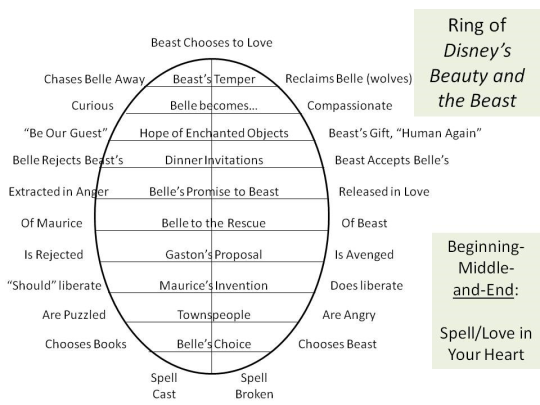
To illustrate what a more complicated ABCDEFGFEDCBA structure looks like, (but not as complicated as Harry Potter’s, which you can see here and here) Susan Raab has put together a fantastic visual of ring composition in Beauty and the Beast (1991), a movie which most agree is almost perfectly structured.
What’s so wonderful about ring composition in this story is that it so clearly illustrates how that one crucial decision of Beast changes everything in the world of the story. Everything from the first half of the story comes back in the second half, effected by Beast’s decision. This gives every plot point more weight because it ties them all to the larger story arc. What’s more, because it’s so self-referential, everything feels tidy and complete. Because everything has some level of importance, the world feels more fully realized and fleshed out. No small detail is left unexplored.
How great would Beauty and the Beast be if Gaston hadn’t proposed to Belle in the opening, but was introduced later on as a hunter who simply wanted to kill a big monster? Or if, after the magnificent opening song, the townspeople had nothing to do with the rest of the movie? Or if Maurice’s invention had never been mentioned again after he left the castle?
Humans are nostalgic beings. We love returning to old things. We don’t want the things we love to be forgotten.
This is true of readers, too.
We love seeing story elements return to us. We love to know that no matter how the story is progressing, those events that occurred as we were falling in love with it are still as important to the story itself as they are to us. There is something inside us all that delights in seeing Harry leave Privet Dr. the same way he got there–in the sidecar of Hagrid’s motorbike. There’s a power to it that would make any other exit from Privet Dr. lesser.
On a less poetic note, readers don’t like to feel as though they’ve wasted their time reading about something, investing in something, that doesn’t feel very important to the story. If Gaston proposed to Belle in Act 1 and did nothing in Act 3, readers might ask “Why was he even in the movie then? Why couldn’t we have spent more time talking about x instead?” Many people do ask similar questions of plot points and characters that are important in one half of a movie or book, but don’t feature in the rest of it.
Now, ring composition is odiously difficult to write, but even if you can’t make your story a perfect mirror of itself, don’t let story elements leave quietly. Let things echo where you can–small moments, big moments, decisions, characters, places, jokes.
It’s the simplest way of building a story structure that will satisfy its readers.
If there’s no place for something to echo, if an element drops out of the story half-way through, or appears in the last act, and you simply can’t see any other way around it, you may want to ask yourself if it’s truly important enough to earn its place in your story.
Further reading:
If you’d like to learn more about ring theory, I’d recommend listening to the Mugglenet Academia episode on it: x
You can also read more about symmetry in HP here: x
And more about ring structure in Lolita and Star Wars here: x and x
And about why story endings and beginnings should be linked here: x
I saw bits of this discussion on twitter, and it inevitably comes up every time someone decides to market a book as a “romance” even though the book has no HEA (happily ever after) or HFN (happy for now) ending. And then wonders why readers lose their shit. Then inevitably the commentary starts (almost always from non-romance readers, usually male) that happy endings aren’t realistic. This is a great response to that.
Aside from “the story must revolve around a romantic relationship”, the happy ending is the single most important element of any story in the romance genre. Period. For a book to be a romance, the story has to be about a romantic relationship of some sort, and the story has to end with all the participants of said relationship (regardless of number, gender, sexuality, etc, etc) happy and together for the foreseeable future. That’s it. If it doesn’t have both of those things, it is not a romance. (Nicholas Sparks does not write romance.)
And some writer out there ALWAYS decides they’re gonna be ‘edgy’ and write a romance with a downer ending. Seriously: do not fuck with romance readers, and do not fuck with their happy endings.
(And before anybody yells about ‘there’s no suspense because you always know the ending’, the tension in a romance novel is driven by the reader’s emotional involvement, and by not knowing how the happy ending will come about or what it will look like. It’s the writer’s job to make the happy ending seem all but impossible, and then pull it off.)
I’m gonna give you some drama, but there’s an HEA…
Oh, I’m firmly in the “readers need to be challenged” camp.
Specifically, they need to be shown that stories do not have to be set in nihilist grimdark dystopias where everyone is raped, tortured and abused; they need to be shown that characters can be kind and that this is not a sign of weakness, but strength; they need to be shown that there is hope and that the world can be made better without sacrificing morals, integrity, or, yes, kindness.
I want to show the shitty edgelords that their misanthropy is myopic, that there is a happily ever after to aspire to for characters, societies, and species.
… Can you write the next star wars film please Orjan?
You’ve been seeing different comedians than me. When Richard Pryor devoted part of his standup to riffing on deliberately setting himself ON FIRE he had me laughing and sobbing at the same time. Comedy is usually based on pain. Listen to John Mulaney as he talks about being small, odd and anxiety ridden as a kid.
Readers should be challenged by boring endings? Have you seen the third movie in the “Divergent” series? NO, you haven’t. The second movie was so boring they actually dropped the series!!
Yeesh
I haven’t seen Divergent at all. But I know I’m getting really sick of the ‘oh let’s KILL EVEYYONE that’s so clever and edgy!’ thing that’s got hold of everyone at the moment. I want to come out of the cinema happier than I went into it. That’s not happening much right now.
I agree with that @icantbearsedtothinkofone. I had been seeing the series with a kid who was desperate to see them and no one wanted to watch with him. I knew what that was like so I volunteered. The second film put us both to sleep. It redefined boring and the only challenge it presented was staying awake.
I am really over the dark, miserable films. I want to have a respite from sadness.
There’s room for sad and challenging films and books, sure. But they need to stay in their fucking lane. The thing with a romance or a cheesy action film or a comics adaptation etc is that it’s like a roller-coaster at the zoo. You’re go on it to have a lot of twists and ups and downs and excitement *while knowing you’re going to be OK at the end*. Not dropped into the crocodile pit. Feels like we’re being offered a lot of crocodile pits right now. And it’s not doing great things to my mental health.
i just Cannot deal w/ gritty edgy Ultimately There Is No Hope And Everything Is Shit type of plots like my mood and morale are already low as is in real life and i don’t.. need the fiction i consume often to cope to be that disheartening? idk like. i just can’t do it anymore. i can’t put myself through it. i know it’s Not That Deep but also i just love.. corny cliché Hope Wins types of stories? it’s not even corny or cliché to me? it’s just. cathartic.
Look, there’s nothing inherently Deep about cynism and pessimism and there’s nothing inherently shallow about hope and optimism. We gotta get away from that idea.
frodo and sam’s love for each other is literally the only thing keeping middle earth from just spontaneously combusting
No, but like, that’s literally it. Gandalf straight-up says to Elrond this Quest can’t succeed by force or wisdom, but by friendship. If Frodo and Sam hate each other even a little, Middle-Earth is doomed.
And it gets more terrifying when you realize that one of the strongest powers of the Ring is to turn people against each other, and that even if it didn’t, the Ring and the Quest still put Frodo in a psychological state where he can barely keep himself sane, let alone love anyone or anything other than the Ring. In fact, I’m fairly sure the Ring tried to persuade Frodo to kill Sam far more often than the books shows – the Ring tends to encourage murder, from what we see. Instead of listening to the Ring, Frodo somehow manages to keep in the back of his mind that he can trust Sam more than he can trust himself, and I have no idea how Frodo can resist the temptation to think his trust is misplaced.
And sure, one could say, “Oh, but Sam has to understand it, so it’s not all that bad” but you have to remember Sam is a plain, non-Tookish hobbit with no inclination or skills for adventuring around and yet he has to become the entire Fellowship. Name one thing the Fellowship did for Frodo that Sam doesn’t also do. He has to advise, guide and protect him as well as keep his hope alive and remind him of who he is. The amount of pressure he’s under is incredible, and unlike, say, Aragorn, he has no experience to draw from. Plus, Merry and Pippin tend to rely on each other, while Frodo relies on Sam, but Sam himself hardly seems to have anyone to turn to for strength. I’m not saying Frodo doesn’t support him as well as he’s able – actually, Frodo is remarkably consistent about taking care of Sam from Book I to Book VI. But what Frodo is capable to offer (see the paragraph above) is far from being all that Sam needs. And actually, in the last stages of the Quest, Sam is basically living a one-sided relationship under the worst possible conditions, and that his devotion doesn’t even waver despite that just blows my mind.
That the Quest was successful is one of the most incredible and beautiful things that Tolkien wrote. Frodo and Sam walked straight into the Land where no love can exist and managed to become closer to each other than they had been. It’s the biggest fuck you Sauron probably ever got. No, seriously. Frodo and Sam beat a Maia basically by cuddling a lot and talking about food. Like, what the fuck??? I mean, if I told you someone could write a 1000 pages novel in which a pacifist and his gardener beat a minor god via supporting each other emotionally, would you believe me?
It’s classic Tolkien: the surprise element (i.e. flawed creatures can be incredibly noble even under unspeakable distress) might overcome even the most carefully thought out plots devised by powerful evil lords. (See also: the entire Silmarillion, pretty much.)
Flawed, unexpected, and usually disparaged persons. ie dancing elven girl, (lower class) gardener…
A movie where a mostly average dude accidentally stumbles across a valuable magical artifact, which is a key piece of contention in a war between the forces of good and evil. The forces of evil attack his home, and the confused man is nearly killed, but is rescued from certain death by a mysterious, beautiful young woman.
The young woman takes him to a secret hideout, where her father, a wise old wizard, has been secreting away key weapons and artifacts so that the forces of darkness cannot destroy them. The young woman proceeds to get into an argument with her father. Legends tell of a champion of the light, who is destined to rise up and use the tools that they have been hiding to defeat the darkness. The young woman has been training with most of these tools for all of her life, and now, as they have obtained the last artifact, she feels it is imperative that they act. The darkness will come for them. They cannot simply wait for that to happen.
But the wise old wizard rebukes her. She is arrogant to think that she is the legendary champion. Destiny often works in more subtle ways, and destiny has brought to them another option: the random dude she just rescued.
Disgusted, the daughter storms off. The random dude moves to go after her, but the old wizard stops him. His daughter is headstrong, and she is passionate. She wishes to fight, but she must learn patience, and appreciation for other paths in life. The old wizard has had more time to appreciate the paths of fate. The random dude has much potential – though of course, he doubts it and refutes it, baffled but unable to leave for fear of being tracked down by the forces of darkness again.
The next day, the old wizard announces that it is time to begin his training.
The random dude goes through precisely one day of gruelling magical/physical tutelage, and then books it to where the daughter is still brooding by a waterfall. Last night he saw this chick suplex a motorcycle and summon up a wall of fire with her bare hands. Dude is not an idiot. He is not going to match the skills of someone who has spent a lifetime training at this stuff, no matter how sexist her father is. He makes a suggestion – he’ll distract the old man with training montages, while the daughter takes all the mystical artifacts and goes to defeat the forces of darkness. It’s the perfect plan! Even if the forces of darkness are still after them, and they come here, then he and the old wizard can serve as a red herring. Meanwhile, the daughter can do whatever she thinks she needs to do to defeat them!
For about five minutes the daughter waffles, because maybe that is arrogant, to think that she is a legendary hero. She’s been living her whole life with the Wizard of Undermining Women’s Contributions, after all.
But the random really is a good dude, so rather than deciding he must have a Destiny, or explaining that her father is probably just trying to protect her, or asking him to help learn instead, he clasps her shoulder and looks her in the eye and is just like:
“You flip-kicked a truck. Normal people can’t do that. So I’m thinking you deserve the benefit of the doubt.”
The daughter concedes his point. After all, she saw him struggling to carry those two buckets up the hidden mountain, and her dad’s not even making him try to do it with his mind yet.
They go through with the plan. The daughter steals all the artifacts/weapons and then has another ‘fight’ with her father, which prompts him to seal all the locks on the already-empty treasure room. Announcing her intention to go sulk, she then takes the mystical items of destiny and fucks off on an epic quest to defeat the forces of darkness.
Occasionally we cut back to the random dude still training with the old wizard. This is the comic relief portion of the film, featuring various hijinks as the dude tries to keep the wizard from discovering that all the mystical artifacts are gone and that his daughter isn’t still just hanging out by the waterfall or in her room or something. Occasionally the wizard wants to find her to help with the training or because ‘nothing motivates a man like a beautiful woman’, and the dude just has to keep dodging it.
Meanwhile the daughter gets the action hero plotline, recruiting new allies and engaging in dangerous, pitted battles across various harrowing landscapes. She bonds with a love interest and wrestles with the temptation to join the forces of darkness, but ultimately finds her great internal reason to fight, beyond the burning desire to prove herself or meet impossible standards.
Of course, for the dramatic climax the forces of darkness attack the hidden sanctuary where her father and dude are. The daughter and her allies rush to defend the place, as the old wizard tells random dude to take his daughter and flee, while he holds off the forces of darkness. Random dude finally explains, however, that the old wizard’s daughter has been gone this entire time. And rather than dying in a spectacular last-stand, the old wizard is stumped as his newest pupil helps hold off the attacking forces long enough for the fully-equipped and supplied champions of light, led by the daughter, to arrive and defeat the armies of darkness before the sacred sanctuary is overtaken and destroyed.
Afterwards, the old wizard is shocked at first. But then he nods sagely to himself. Of course, the random dude was the hero after all – if he had not stayed, then surely the sanctuary would have been lost. His actions led the old wizard’s daughter to victory, and surely now that they have been reunited, the random dude will take his rightful place as a champion of the light. And also probably marry the wizard’s daughter, and produce a suitable male heir…
Everyone basically just tunes him out as the random dude and the daughter fistbump, and the dude sags in relief when the daughter explains that he can go home now and then drops like a sack full of gold into his arms to try and compensate him for all the trouble.
~ Fin
You had me at “distract the old man with training montages”.
‘staring into the camera like you’re on the office’ is such an interesting cultural phenomenon because it points to one of my very favorite things in pop culture, which is the use of commonly known fictional situations to indicate an emotion or context that is extremely specific and can’t necessarily be communicated with language alone.
why do characters on the office look into the camera? on the office, the characters are being filmed as part of a documentary; they understand they are being filmed and can acknowledge that fourth wall and those theoretical future viewers. but because the office is a comedy, that fourth wall acknowledgement is not about explaining motivations or gaining approval for an action, but about sharing an agreement with a group of people who are not actually there.
characters on the office look into the camera when something ridiculous is happening that no one in the room thinks is ridiculous but the person looking at the camera, were they to say ‘this is so ridiculous’ to the people in the room, their comrades in fiction, they would get serious pushback or anger; to those characters the situation is serious. the character looking into the camera is a more objective viewer, like the audience, and by looking at us they’re putting themselves on our objective team. and in the future when this ‘documentary’ would air, they would be vindicated as the person who understood that the situation was ridiculous.
so in real life, when we talk about ‘looking into the camera like we’re on the office’, this very specific emotion is what we’re referring to: that we’re in a situation that any objective viewer would find inherently ridiculous, and are seeking acknowledgement from an invisible but much larger group that would agree with us, even though nobody in the situation would do so. we’re putting ourselves in an outsider position, a less emotional position, and inherently a more powerful position, because we’re not vulnerable to being laughed at like all the ridiculous people we’re among. we’re among them, but we’re not with them, and the millions of people watching us on theoretical tv would be on our team, not theirs. that’s such a specific idea and concept, and one that’s really hard to communicate in pure language. but we can say ‘looking into the camera like we’re on the office’ and it’s much easier to communicate what we mean.
for me that’s what pop culture is for, and why it’s so important that it’s pop culture. maybe it feels more special if it’s only you and a grape who know that something exists, but the more people consume something, the more its situations and reactions become common knowledge, a sort of communal well from which we can draw to articulate real life problems. and ultimately, the easier it is for us to communicate and understand each other.
We used to cast our eyes to heaven in lone exasperation, now we deadpan at an imaginary camera
the older I get, the less patience I have for the idea that a story is inherently complex or #deep because it has a bittersweet or tragic ending, or that people who like for things to end on a happy note are simple-minded weaklings who can’t handle harsh realities and mature storytelling.
Look, shit is fucked. Life is a mess. Sometimes it’s a struggle to even come up with a reason to go on. I respect that media should be realistic and true to life, but fucking sue me, for once I just want to see the bad guys eat shit while the good guys ride off into the sunset and never have anything bad happen to them ever again. I don’t care if it’s unrealistic or implausible, that’s why it’s a fucking story. I have enough tragedy in my real life, thanks.
i adore how much Dirty Millennial Writers focus on found family as a central theme. we love it so much! we all just wanna move in together in a big house with all of our friends and marry everyone, and i think that’s nice
about me
I push this in story meetings all the time ❤
Especially queer writers! We are allabout found family! I’m pretty sure every major thing I’ve written has an element of found family.
I am all for poc being cast in roles that highlight their cultural history and struggles
But can we also campaign for giving poc roles that are about an average person with average problems????? Roles that are given to white people by default…….
A black girl in a romance movie where the greatest obstacle isn’t her race and the greatest reward isn’t that she ends up with the white dude…….
A romantic comedy where all the poc characters aren’t stereotyped by what Hollywood classifies as their culture…..
A coming of age story starring a diverse group of children instead of a token (stereotyped) minority character…..
Can we make movies that don’t make the family dynamics in black or latinx culture dramatic or toxic?????
Can we have more Muslim representation in general????????
Can we show non-christian religions as more than oppressive?????
Can we give poc more roles than the ones that were “written for them”?????
Can we make movies showing the true diversity of society rather than trying to convince ppl that poc are just sprinkles in a white world ????????



 Steel Phoenix Studios
