Earth is a complex, dynamic system. For 60 years, we have studied our changing planet, and our understanding continues to expand with the use of new technologies. With data from satellites, instruments on the International Space Station, airborne missions, balloons, and observations from ships and on land, we track changes to land, water, ice, and the atmosphere. Application of our Earth observations help improve life now and for future generations. Since we opened for business on Oct. 1, 1958, our history tells a story of exploration, innovation and discoveries. The next 60 years, that story continues. Learn more: https://www.nasa.gov/60
Make sure to follow us on Tumblr for your regular dose of space: http://nasa.tumblr.com.
We’re set to launch ICESat-2, our most advanced laser instrument of its kind, into orbit around Earth on Sept. 15. The Ice, Cloud and land Elevation Satellite-2 will make critical observations of how ice sheets, glaciers and sea ice are changing over time, helping us better understand how those changes affect people where they live. Here’s 10 numbers to know about this mission:
One Space Laser
There’s only one scientific instrument on ICESat-2, but it’s a marvel. The Advanced Topographic Laser Altimeter System, or ATLAS, measures height by precisely timing how long it takes individual photons of light from a laser to leave the satellite, bounce off Earth, and return to ICESat-2. Hundreds of people at our Goddard Space Flight Center worked to build this smart-car-sized instrument to exacting requirements so that scientists can measure minute changes in our planet’s ice.
Sea ice is seen in front of Apusiaajik Glacier in Greenland. Credit: NASA/JPL-Caltech/Jim Round
Two Types of Ice
Not all ice is the same. Land ice, like the ice sheets in Greenland and Antarctica, or glaciers dotting the Himalayas, builds up as snow falls over centuries and forms compacted layers. When it melts, it can flow into the ocean and raise sea level. Sea ice, on the other hand, forms when ocean water freezes. It can last for years, or a single winter. When sea ice disappears, there is no effect on sea level (think of a melting ice cube in your drink), but it can change climate and weather patterns far beyond the poles.
3-Dimensional Earth
ICESat-2 will measure elevation to see how much glaciers, sea ice and ice sheets are rising or falling. Our fleet of satellites collect detailed images of our planet that show changes to features like ice sheets and forests, and with ICESat-2’s data, scientists can add the third dimension – height – to those portraits of Earth.
Four Seasons, Four Measurements
ICESat-2’s orbit will make 1,387 unique ground tracks around Earth in 91 days – and then start the same ground pattern again at the beginning. This allows the satellite to measure the same ground tracks four times a year and scientists to see how glaciers and other frozen features change with the seasons – including over winter.
532 Nanometer Wavelength
The ATLAS instrument will measure ice with a laser that shines at 532 nanometers – a bright green on the visible spectrum. When these laser photons return to the satellite, they pass through a series of filters that block any light that’s not exactly at this wavelength. This helps the instrument from being swamped with all the other shades of sunlight naturally reflected from Earth.
Six Laser Beams
While the first ICESat satellite (2003-2009) measured ice with a single laser beam, ICESat-2 splits its laser light into six beams – the better to cover more ground (or ice). The arrangement of the beams into three pairs will also allow scientists to assess the slope of the surface they’re measuring.
Seven Kilometers Per Second
ICESat-2 will zoom above the planet at 7 km per second (4.3 miles per second), completing an orbit around Earth in 90 minutes. The orbits have been set to converge at the 88-degree latitude lines around the poles, to focus the data coverage in the region where scientists expect to see the most change.
800-Picosecond Precision
All of those height measurements come from timing the individual laser photons on their 600-mile roundtrip between the satellite and Earth’s surface – a journey that is timed to within 800 picoseconds. That’s a precision of nearly a billionth of a second. Our engineers had to custom build a stopwatch-like device, because no existing timers fit the strict requirements.
Nine Years of Operation IceBridge
As ICESat-2 measures the poles, it adds to our record of ice heights that started with the first ICESat and continued with Operation IceBridge, an airborne mission that has been flying over the Arctic and Antarctic for nine years. The campaign, which bridges the gap between the two satellite missions, has flown since 2009, taking height measurements and documenting the changing ice.
10,000 Pulses a Second
ICESat-2’s laser will fire 10,000 times in one second. The original ICESat fired 40 times a second. More pulses mean more height data. If ICESat-2 flew over a football field, it would take 130 measurements between end zones; its predecessor, on the other hand, would have taken one measurement in each end zone.
And One Bonus Number: 300 Trillion
Each laser pulse ICESat-2 fires contains about 300 trillion photons! Again, the laser instrument is so precise that it can time how long it takes individual photons to return to the satellite to within one billionth of a second.
she didn’t lose her internship because “her friends” used a hashtag, she lost it because a bunch of 4chan fuckers found out she’s trans and decided to doxx her and harass her employer about the ~image~ she was sending. like this wasn’t her public face account, she wasn’t spouting racist garbage, she mistook someone in her mentions for one of the randos she gets regularly harassed by (because, yknow, if someone tweets “language” at you on twitter, 99.9% of the time they’re not actually concerned for you) and transphobes used the opportunity to fuck up her life. it’s great that hickam is behind her on this but a lot of people are sharing this and laughing at how hilarious it is that “a furry got fired for swearing”, which is the smokescreen being used to cover how this was doxxing a trans woman to ruin her potential career
SPACE LESBIANS GONNA COLONISE MARS, MAKE IT A BEAUTIFUL SAPPHIC UTOPIA ❤
its actualy really fascinating, the reason they are considering making the mission to mars all female ACTUALLY doesnt have to do with “impure sexual thoughts” or anyhing it has to do with a multitude of factors, for example (cis) women astronauts tend to be smaller and require less food, nasa also did a series of studies showing that in groups, all woman groups showed better cooperation and teamwork than mixed or all men groups, and also probably the most interesting reason is that (cis) mens eyesight is damaged in space travel for reasons we dont even understand yet, for some strange reason the vast majority of men who have been into space have suffered damage to their eyesight and yet almost no women have had this issue, and scientists are still trying to figure out why but in the meantime sending men into space for long periods of time is a huge concern because they may go blind over time … just thought that that headline was a little reductionist and sensationalist so i had to comment, that being said tho…
HELL YEAH SPACE LESBIANS
SPACE LESBIANS IN SPACE
IN SPAAAAAAAAACE
SPACE! THE LESBIAN FRONTIER!
“These are the gay-ventures of the Starship Lez-terprise”
KIRK IS HOLDING A ZINNIA. THE SAME FUCKING FLOWER.
FUCKING NASA MAN
No. Nononono. You don’t understand.
I am so mad about this. Like, not like I wanna kill someone, but mad, as in, hysterical?
They wanted to answer questions about plants in space, right? How biology and botany would work in space. Because then who knows? We could grow crops in space, or fix the atmosphere. Or create the perfect biome for plants that are now extinct. Who fucking knows, right?
They could have taken a food crop. Wheat, maybe. Or rice. Something they could observe to see if it would be possible to solve a food shortage or whatever. Maybe a small apple tree to see if it would bloom, and then see if there could be a way to make it fruit.
Or, you know, go the genetics route and take a sweet pea. See if zero gravity does anything to how genes are passed on. Mendel did it in a shed, why not a tin shed in outer space, right? Oh the possibilities.
Was it so wrong to take the zinnia? No, of course not. In my little horticultural brain, I thought, oh how lovely! A splash of colour in the emptiness of space. Something bright and cheerful, something that gives hope. That must have been it, right?
But no.
SOMEONE went, “Nah, mate, here’s an episode of Star Trek where Kirk is holding a ZINNIA in a SPACE DESERT.”
I could scream. I don’t know if I love or hate these fucking nerds. Oh my gods.
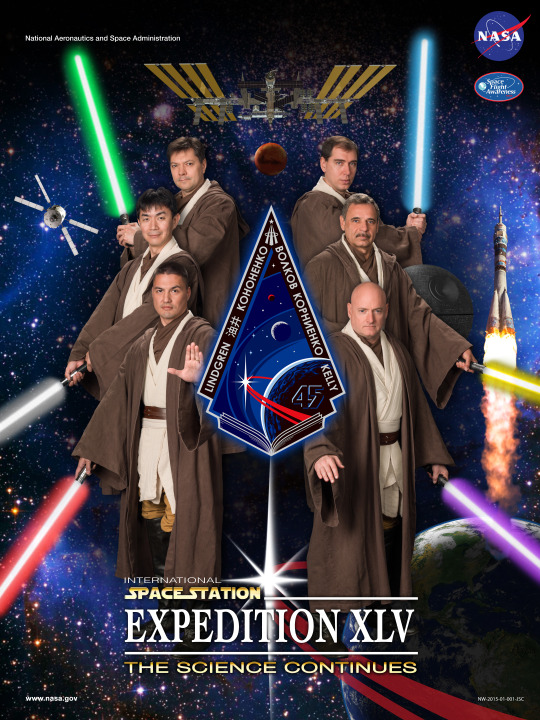
This is Kjell Lindgren. He’s a NASA astronaut who just got back from 5 months on the International Space Station. There are two reasons why this picture is hilarious:
His wife is flawless and makes bad space puns to make him do household chores.
I have that shirt. Thousands of people have that shirt. That shirt is available at Target. Which means actual astronaut Kjell Lindgren, with his wardrobe already full of NASA-issued and logo-emblazoned clothes, was at Target, saw a NASA shirt, and was like, “Yes, I am buying this because this is what I want to spend my actual astronaut salary on.”
tl;dr NASA employs a bunch of fucking nerds
It gets better.
Courtesy of Wikipedia, here’s the poster NASA released for his mission to the ISS:
NASA confirmed for a bunch of fucking nerds
*wipes single tear*
They’re just too beautiful.
I’ve said it before, I’ll say it again.
NASA personnel are, like, the top nerds. The alpha nerds. The absolute nerdiest nerds. The nerds other nerds look to for nerdspiration.
A soccer ball that was aboard the Challenger shuttle when it exploded
in 1986 — and surprisingly found intact amid the wreckage — has finally
made its way back into space.
The miracle ball was launched into orbit last week, just days after
the anniversary of the tragedy. It belonged to NASA astronaut Ellison
Onizuka and had been signed by the Clear Lake High School boys and girls
soccer teams, of which his daughter was a member.
“This ball was on Challenger that fateful day,” astronaut Shane Kimbrough tweeted, along with a picture of the black-and-white soccer ball floating outside the International Space Station.
“Flown by Ellison Onizuka for his daughter, a soccer player,” he said.
…Kimbrough, who is commander of the ISS’s Expedition 50 crew, went on
to reference Clear Lake High School in his tweet, adding the hashtag
#NASARemembers.
Like Onizuka, his son is currently a junior at the school and also plays sports.
“It has continued to travel and explore space, while inspiring so many through its history,” she said.
After Challenger broke apart, Onizuka’s soccer ball was recovered
among the wreckage that fell into the ocean. Several other items that
belonged to him were also found floating in the water, including a
football and an American flag.





 Steel Phoenix Studios