Roads and paths pervade our literature,
poetry, artwork, linguistic expressions and music. Even photographers
can’t keep their eyes (and lenses) off of a beautiful road or path,
which is why we collected this list of 28 amazing photos of paths. Source: boredpanda
Autumn In The White Carpathians
Rhododendron Laden Path, Mount Rogers, Virginia, USA
hello. i am writing to let you know you did good job on the stars, and also on cats.
yours respectfully, me
dear universe,
in the original post of this, it says “dogs” where it now says “cats”. i do not know when (or how) it got changed, but i am glad that someone loved cats enough to do that, because i love my dog and i also love my cats and i felt bad about not mentioning it that first time. i’m also glad for all the tags where people told me what i should have added (like libraries and waffles and maple syrup) and i am glad for all the comments about how much they love their pets (and some people have such cool pets!)
i kind of think, universe, if we are your children, this is our macaroni art. see, see, see, you gave us a little bit of the stars, and we’ve made our own constellations. we tried to give back to you by making art and music and books and bad poetry and our laughter and our love and our tv dramadies. we took pictures of the night sky and pictures of sunsets and pictures of dew, we fell in love with space and the rivers and the rain. i personally have my desktop background as a picture of one of your nebulas. your hair looked great that day.
i think…. you did a good job, universe, on the stars, and what the stars became, because you put us together and yes, yes, things might be terrible – but good gracious did we make so many things worth loving, worth writing to you about, worth telling you – thank you, i’m taking the spark you put in me and using it to be kind, to be alive, to be wildly fierce about our gardens and gentle about our pets.
so hello. i amend my previous memo. i am writing to let you know you did a good job on the stars, and on my dog and my cats and the lizard i kept illegally in my apartment. and universe, i hope you’re watching, because some of the people you made? they’re great, universe, and they’re full of love, just endlessly capable of loving. and they give me hope.
and through them, universe, that’s you. that’s how the stars sing.
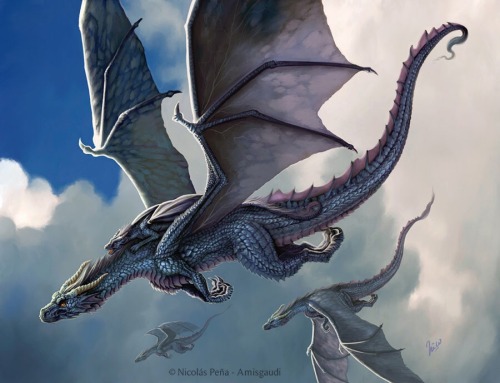
The eyes-in-the-front thing (usually) only applies to mammals. Crocodiles, arguably the inspiration for dragons, have eyes that look to the sides despite being a predator.
hey what up I’m about to be That Asshole
This isn’t a mammalian thing. When people talk about ‘eyes on the front’ or ‘eyes on the side,’ they’re really talking about binocular vision vs monocular vision. Binocular vision is more advantageous for predators because it’s what gives you depth perception; i.e, the distance you need to leap, lunge, or swipe to take out the fast-moving thing in front of you. Any animal that can position its eyes in a way that it has overlapping fields of vision has binocular vision. That includes a lot of predatory reptiles, including komodo dragons, monitor lizards, and chameleons.
(The eyes-in-front = predator / eyes-on-sides = prey thing holds true far more regularly for birds than it does for mammals. Consider owls, hawks, and falcons vs parrots, sparrows, and doves.)
But it’s not like binocular vision is inherently “better” than monocular vision. It’s a trade-off: you get better at leap-strike-kill, but your field of vision is commensurately restricted, meaning you see less stuff. Sometimes, the evolutionary benefit of binocular vision just doesn’t outweigh the benefit of seeing the other guy coming. Very few forms of aquatic life have binocular vision unless they have eye stalks, predator or not, because if you live underwater, the threat could be coming from literally any direction, so you want as wide a field of view as you can get. If you see a predator working monocular vision, it’s a pretty safe assumption that there is something else out there dangerous enough that their survival is aided more by knowing where it is than reliably getting food inside their mouths.
For example, if you are a crocodile, there is a decent chance that a hippo will cruise up your shit and bite you in half. I’d say that makes monocular vision worthwhile.
Which brings us back to OP’s point. Why would dragon evolution favor field of view over depth perception?
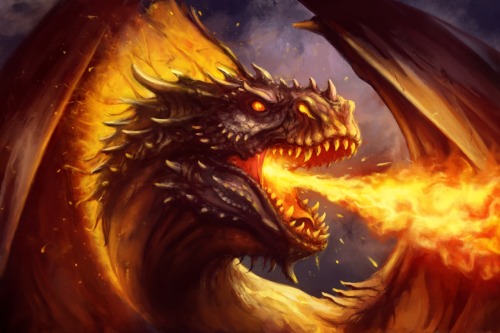
A lot of the stories I’ve read painted the biggest threats to dragons (until knights with little shiny sticks came along) as other dragons. Dragons fight each other, dragons have wars. And like fish, a dragon would need to worry about another dragon coming in from any angle. That’s a major point in favor of monocular vision. Moreover, you don’t need depth perception in order to hunt if you can breathe fucking fire. A flamethrower is not a precision weapon. If you can torch everything in front of you, who cares if your prey is 5 feet away or 20? Burn it all and sift among the rubble for meat once everything stops moving.
Really, why would dragons have eyes on the front of their heads? Seems like they’ve got the right idea to me.
this is some good dragon discourse right here, 10/10, and i dont mean to derail the whole thing away from the eyes, but i feel obligated to mention that in many stories and accurate to some reptiles, dragons have an extremely acute sense of smell/taste which would definitely help narrow down the depth perception issue. things smell stronger the closer they are. and i feel like i read somewhere that a blind snake can flick the air with its tongue and track its target mouse with no trouble at all. gotta imagine the “great serpents of the sky” had some pretty advanced biology. enough to make field of view win out against depth perception.
anywho. cool stuff. fear the dragons even if they are the prey cause they still beat us on the food chain.
I love animals that are, like, the opposite of cryptids: we know for a fact they exist and have a clear idea of what they look like because we have photographs and individual specimens, but we haven’t the faintest idea where they’re coming from – they just keep showing up out of nowhere, and the locations of their actual population centres are a complete mystery.
I so want examples. anyone who knows of any should post them in notes
You know, like giant squid and such. We know the bastards exist, we have credible first-hand accounts stretching back thousands of years and dead specimens washed up on shore and such, but in centuries of searching we’ve managed exactly one well-documented encounter with a giant squid in its natural habitat. We have no idea what their native range is or what their life-cycle looks like, let alone how many of them are out there.
Are there any reverse-cryptids that /aren’t/ at the bottom of the ocean?
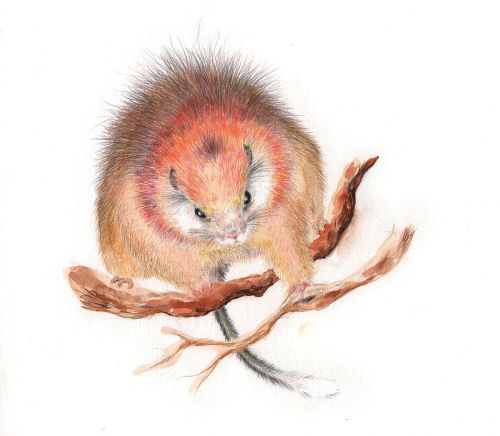
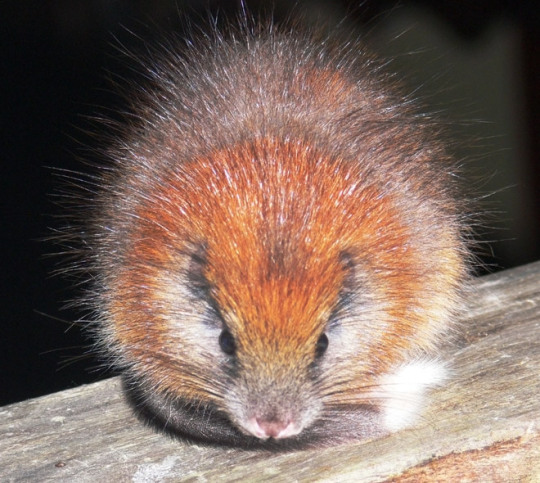
The red-crested tree rat, for one. There have been only three well-documented encounters since 1898, and they just plain disappeared from the zoological record for over a century. The only reason we know they’re not extinct is that one walked right up to a couple of wildlife research interns at a Columbian nature reserve back in 2011, apparently out of pure curiosity, and allowed itself to be photographed and observed for several minutes before disappearing again.
That’s genuinely pretty cool and all, but I absolutely need to talk about how the picture in that Wikipedia article looks like a tiny eldritch horror disguising itself as a peach.
To be fair, based on the actual photos from the 2011 encounter, they really do look like that:
He’d want a bouquet of these, you just *know* it. (I bet he’d also have raised a giant one in the greenhouse he has in the Jedi Temple grounds. It’s one of his proudest achievements).
These are the ones who smell like rotting dead meat, I think xd
2.fun fact this bat isnt being eaten; like, its roosting there for the night. this is Nepenthes hemsleyana, a pitcher plant species in a mutualistic relationship with the local tiny bat friends Kerivoula hardwickii (Hardwicke’s woolly bat)!! it works like this:
– the pitchers are shaped to make a special distinctive reflection of the bat’s echolocation. so like, the bats can hear where the pitchers are and go to them for roosting.
-the bats enter the pitchers and sit on this special rim inside that holds them above the water line so they dont get eaten on accident.
-up to two teeny bat friends can fit in an average pitcher at a time lmao
-the bat friends poop when they sleep and the plant eats the poop when it falls into the digestive fluid
The context behind this image is even fucking funnier imo. Dolphins will bonk this kind of puffer fish because when it puffs up it also release a toxin that’s normally deadly to other fish but just gives dolphins a mild high
“Andy Goldsworthy is an extraordinary, innovative British artist whose collaborations with nature produce uniquely personal and intense artworks. Using a seemingly endless range of natural materials—snow, ice, leaves, bark, rock, clay, stones, feathers petals, twigs—he creates outdoor sculpture that manifests, however fleeting, a sympathetic contact with the natural world. Before they disappear, or as they disappear, Goldsworthy, records his work in superb colour photographs.”
There is a documentary on him and his art on youtube! It’s called Rivers and Tides and it is fucking amazing and incredibly inspiring everyone should see it.




 Steel Phoenix Studios