A small list of random ass sites I’ve found useful when writing:
Fragrantica: perfume enthusiast site that has a long list of scents. v helpful when you’re writing your guilty pleasure abo fics
Just One Cookbook: recipe site that centers on Japanese cuisine. Lots of different recipes to browse, plenty of inspiration so you’re not just “ramen and sushi”
McCormick Science Institute: yes this is a real thing. the site shows off research on spices and gives the history on them. be historically accurate or just indulge in mindless fascination. boost your restaurant au with it
Cocktail Flow: a site with a variety of cocktails that’s pretty easy to navigate and offers photos of the drinks. You can sort by themes, strengths, type and base. My only real annoyance with this site is that the drinks are sometimes sorted into ~masculine~ and ~feminine~ but ehhhh. It’s great otherwise.
Tie-A-Tie: a site centered around ties, obviously. I stumbled upon it while researching tie fabrics but there’s a lot more to look at. It offers insight into dress code for events, tells you how to tie your ties, and has a section on the often forgotten about tie accessories
Even more:
Types of High Heels: A page describing twenty five different types of high heels. It gives a description and pictures. Shake it up from just “stilettos and kitten heels”
Random Job Generator: Exactly as it says. The site offer more generators like characters, plots, or town names.
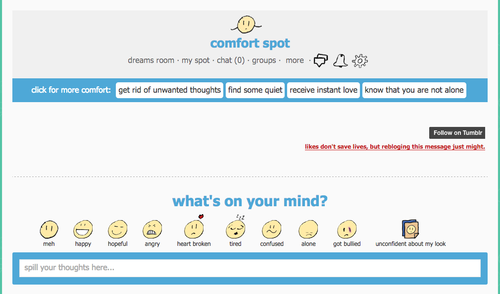
Okay so I’m sure you’ve all heard of the quiet place project. Well if not I am going to tell you because it has stopped me from doing serious damage more than once.
This gem right here is where you can literally create a 100% anonymous username and just absolutely spill your guts. Then people can read it and give you advice, and it honestly is so helpful. Because the other people on it are in the same situations as you, and they understand. You can comment and give advice on other peoples posts too, and it’s just really great.
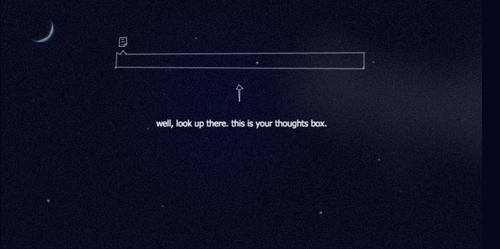
This little beauty is similar to the comfort spot. Except instead of posting your thoughts, you type them into the box and then when you press enter they disappear and turn into stars against the blue sky. There is a whole bunch of different languages to choose from at the start, so if English is not your first language then you can probably find it here. There is the most comforting music that plays in the background as well, which is so great.
Which is so good for panic related things because it silences all of your other tabs and when you make it full screen it talks to you very calmly and then literally forces you stop for just 30 seconds and do nothing and just breathe.
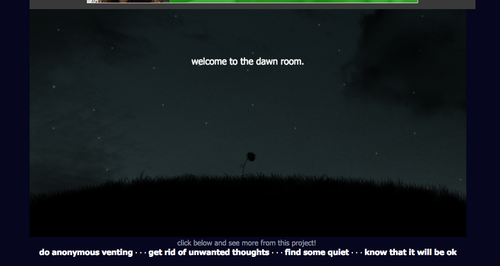
Okay, so this is my actual favourite, it’s called the dawn room
The dawn room is so great for stopping you from self harming. It begins by telling you that its going to be alright, then it asks you to write something about someone you love. After that messages from other people, just like you, appear on the screen, one after the other, and the background slowly become brighter and happier. This page has genuinely stopped me from hurting myself more times than I can count. I’m not suggesting that it will work for everyone, but it is an absolute gem.
This page runs for about 5 minutes, and it is basically a typing simulator that tries to convince you that everything is going to be alright. It is very calming, and good for lonely times.
I can honestly say that this website has done me so so much good. I appreciate it with every bit of my being.
please reblog
this sounds so lovely
I love this
if you wanna help people, please.
reblog it.
So I reblogged (rebloged?) it before using, and now that I used I can say.
For years, Canadians have been able to watch episodes of iconic American classics such as “The Mary Tyler Moore Show,” “Batman” or “I Love Lucy.” But where was Canada’s TV heritage? Why was our homegrown fare always, after its initial run, locked away in a vault?
Well, “The Littlest Hobo” has finally been let out of his kennel. After years of development, the Canada Media Fund and Google Canada have teamed to launch encore+, a new YouTube channel giving viewers here and around the world access to decades of Canadian film and TV gold.
OMG OKAY SO. If you’ve been following me since the LJ days, this is your golden opportunity to experience some of the things I used to go on and on and on about.
–They have the whole first season of DaVinci’s Inquest. This is not the best season of DVI, but it’s still good and worth watching. Features Ian Tracey, who you know if you’ve watched anything filmed in Vancouver ever, Gwyneth Walsh aka The Less-Intellectual Duras Sister, Donnelly Rhodes, another anything-filmed-in-Vancouver-ever actor, and a young Jewel Staite, who needs no fannish introduction.
–They have some of This Is Wonderland. In the absence of Power Play (if this channel uploads PP, it will get its own post), this is your best introduction to the force of acting nature that is Michael Riley. If you watched Being Erica, you may think you know him already, but trust me, you do not.
–They have Due South, but if you’re in fandom you very likely already know dS.
–They have s1 of Slings & Arrows, which is JUST THE BEST THING. (Also: HILARIOUSLY PRESCIENT. Although that doesn’t happen until s2.) It has Paul Gross and Rachel McAdams and Mark McKinney and DARREN NICHOLS. DEAL WITH THAT.
–They have The Littlest Hobo, which all non-Canadians should watch at least one episode of just for the ~experience~.
–Other notables: Little Mosque on the Prairie, Degrassi Jr High, Ready or Not, Mr Dressup, Are You Afraid Of The Dark?, Incredible Story Studio, various movies and TV movies.
So the Stanley Cup Finals are upon us and I’m guessing a few people who’ve never watched hockey might decide to check it out, especially since no matter who wins this year, it’ll be historic.
A lot of people watching hockey for the first time: OMG WHAT THE HAP IS FUCKENING SO MANY MOVING THINGS.
Worry not. I am Here For You.
What even is going on here. I’m dizzy.
Yeah, that happens. What is going on here is that two teams of six dudes each are trying to get a six ounce rubber puck into the back of the other team’s net. They do this by skating rlly fast, banging into each other, cursing a lot, and flinging the puck around. That’s it, basically. Hockey isn’t very complicated in its basics. There is one way to earn a point (make the puck go into the net) and one way to win (be better at making the puck go into the net than the other guys).
I can’t see the puck WHY SO TINY.
I feel your pain. Watching hockey on tv is a bit of an acquired skill. If it helps, watch the players, not the puck. Ironically, watching it live is WAY easier.
Who are these six dudes?
Each team is allowed six players on the ice. Almost all the time, those six players are three forwards (who are supposed to shoot the puck and score – a group of 3 forwards is called a “line”), two defensemen (who are supposed to stop the other team from being able to score, and get the puck back for their team) and one goalie (whose whole job is to stand in front of the net, be huge and impenetrable, and stop the puck from going in). But except for the goalie, everyone shares in all the jobs to varying degrees. Defensemen often score, and forwards often defend. There is at least one NHL team whose top scorer is a defenseman.
There are way more dudes on the bench. What are they even doing, cheering?
They’re waiting for their turn. Each team can have 23 players on their active roster, but can only “dress” (get geared up and ready to play) 20 players for each game. They usually dress four lines of forwards, three defensive pairs, and two goalies (a primary and a backup – most of the time the backup sits on the bench the whole game. He only goes in if the primary gets hurt or gets scored on a LOT). If you are not familiar with the players and their numbers, you’re probably not noticing that the players on the ice change constantly. Hockey is so strenuous that you can’t do it at full game speed for more than a minute. Forwards play in “shifts” of usually 30-45 seconds, defensemen usually 1 to 2 minutes. They swap out as the coaches direct, without stopping play. I have yet to stop being impressed by this. You often don’t see the changes on TV because the cameras stay with the puck, and the players are changing off-camera.
Wait…what’s a power play? That sounds kinky.
A big part of hockey is penalties. You get penalties for doing not-cool stuff with your stick, your body, your skates. Most are minor penalties (two minutes) – there are also double minors (four minutes) and majors (five minutes). When a team is charged with a penalty, a player goes to the box, usually (but not always) the player who committed the penalty. You’re not allowed to replace the player who’s in the box, so this means his team is short one player, and the other team has an advantage, which is called a power play. Teams have a special group of players for the power play (usually their best forwards) and also a special group for when they’re at a disadvantage (called a penalty kill, heavy on their best defensemen because they want to survive the penalty without getting scored on). It’s possible to have TWO players in the box at once resulting in a 5-on-3 advantage (a two-man advantage is the maximum allowed) and sometimes you’ll get one player from each team with a penalty, resulting in a 4 on 4 period.
Icing? Offsides? These are clearly not cake-decorating terms.
Hockey is played in three periods of twenty minutes each with a 15 minute intermission between them. During those periods, play continues until a whistle is blown or a goal is scored. Whistles are blown for penalties, when the goalie freezes the puck (stops it and hangs on to it so it can’t be played), the puck goes out of play (over the glass or into the bench) or when the teams commit the infractions of icing or offsides. Icing is when someone shoots the puck from behind the center line all the way to the opposite end. You’re not supposed to do that. When the puck is being played toward the offensive zone, the puck has to be the first thing across the “blue line” (the line that marks the beginning of the offensive zone). If an offensive player beats the puck across the line, that’s offsides.
Hey, they’re fighting! That can’t be allowed, right?
Well…yeah, it kind of is. Hockey players frequently get in minor little shovey-shovey sweary shouty skirmishes (this is often referred to as the players getting “chippy”). Those aren’t fights. Real capital-F Fights are actually a stat that is kept for teams and players. An official fight is usually at least semi-planned and the refs are sort of given a heads-up about it, they usually just stand there and let it happen, and the players keep each other from piling on. It’s a real fight if the players drop their gloves and if punches are thrown. Believe it or not, learning to “hockey fight” so you don’t actually injure yourself or the other player is a skill that players are taught. It happens, but usually both players will get some variety of penalty (roughing or fighting depending on the severity and who started it). There was a real fight in last night’s game although it was really more like a minute-long hug session.
They’re totally running into each other. A lot.
Yep. That’s called checking, or hitting. It’s legal to hit a player who has the puck in order to get possession away from him. But there are a lot of rules – you can’t hit someone who doesn’t have the puck, you can’t hit the player with the puck from behind, you can’t hit them above the shoulders or below the knees, you can’t use your elbows, and so forth. Legal hits can still be pretty brutal and how penalties are called for illegal hits is wildly inconsistent. Hits are another stat kept for the teams and it’s a measure of how aggressive they’re being in taking puck possession.
Hey, the players are getting points too, not just the teams.
Yes, they are! Hockey is very team-oriented. It’s extremely rare for a player to score a goal without one of his teammates setting it up for him, or getting the puck to him in a way that enables him to score. Players get equal points in their individual stats for both goals and assists. Each goal has the possibility of two assists – the guy who touched the puck before the goal-scorer, and the guy who touched it before that. Assists are not recorded on every goal, and some goals only have a primary assist and not a secondary. When we talk about players’ stats, the ones most frequently mentioned for forwards are total points (goals + assists), goals, and points per game (goals + assists divided by number of games played). Any player will tell you that the ability to just shoot the puck into the net is not the most important part of offensive play – the ability to “create offense” and set up plays that result in a goal is even more important. Some players are goal-scorers (Alex Ovechkin is one example) and some are players that do more offensive creation (Sidney Crosby is like that).
DUDE THE GOALIE IS GONE. DID HE REMEMBER THAT HE LEFT THE OVEN ON?
If the goalie is gone it’s probably in the last 2 minutes of the game and his team is losing. There is no rule that says you HAVE to have a goalie on the ice and you’re allowed six players, so if you pull your goalie, you can put another forward on to score. If there’s 2 minutes left and your team is down by 1 or 2 goals, if you pull your goalie, the worst that can happen is you’ll lose MORE, and you might be able to tie the game and force overtime, or even win, if you put yourself at a man advantage with an extra skater. This is called an “empty net” situation and it’s nerve-wracking, especially if your team is the one that pulls the goalie. All it takes is for the other team to break away from your defense and they can pretty much score unchallenged. (There is another situation, delayed penalties, during which a team pulls their goalie during other times in the game, but that’s a bit advanced. I can explain it if anyone’s curious)
Um, is it me or do these playoffs take forever?
It’s not you. The Stanley Cup playoffs take forever. Sixteen teams make the playoffs (out of 30, soon to be 31 teams total) and they play four rounds, each of which is a best-of-seven. The winning team at the end could have played as many as 28 games in the post-season – the regular season is 82 games long. There are four divisions in the league grouped into two conferences. Each division sends their top three teams to the playoffs, then each conference sends the next two highest-scoring teams for a total of eight teams per conference. Those eight play for the conference championships, then those last two teams go on to play for the Stanley Cup. This year’s western conference champions, the Nashville Predators, and the eastern conference champions, the Pittsburgh Penguins, are two games in to the final round now. Pens are up 2-0 games in the series. Each round takes about two weeks – the playoffs started April 12 and could end as late as mid-June if the final round goes to seven games.
A lot of these dudes seem to be Canadian.
Yep. Hockey is Canadian for sure. Of the players in the NHL, 50% are Canadian (if you can name a world-famous hockey player there’s about a 95% chance he’s Canadian), 25% are American and 25% are European of some other variety (mostly Russian, Swedish, Czech and Finnish). One of the things about hockey that bugs me is that it’s SO WHITE. There are many reasons for that, but it’s getting better. At this year’s All Star Game there were six minority players invited, and there are some amazing up-and-coming young players of color in the league like Auston Matthews (who will 98% probably win the Calder trophy for Rookie of the Year this year), Josh Ho-Sang, Seth Jones and Nazem Kadri, three of whom played in this year’s playoffs.
There’s a lot of hugging. I did not expect this much hugging.
Hockey players hug a lot. After someone scores it’s pretty much standard for there to be a big hugpile.
Okay, I think I’m good for now.
Awesome! Hockey is fun to watch and hopefully this has been helpful. I enjoy talking about it and learning more stuff myself, so send me an Ask if something confuses you.
THIS IS THE BEST DOCUMENT IN ALL OF HISTORY. Basically, it has a script in it that has a “Post to AO3″ option and it will go in and fill in ALL the HTML you need – italics, bold, paragraph breaks, you name it!
It has directions in it for how to use it, but it’s real simple. You just always chose “Make a Copy” when you start writing to make a new document that you can then re-name. Change the language to American English (or whatever language you use) and type away. Then right before you post, click the button, get all the code in there, copy, paste, AND POST.
It is literally so, so glorious and I want to tell everyone.
(Also, the AO3 Cool FAQ page has some other cool stuff too!)
DAILY FIND: Sometimes the Internet is a crappy place full of crap. But today I’m reminded that it’s an amazing trove of free and good information from reliable sources: The University of Illinois Extension has created a searchable index of every stain known to manand stain removal solutions for each. The tool will even tell you what your window of stain-treatment time is to achieve optimal results.
This is nerd GOLD, people. Use it in good health. -ts
UFYH, have you seen this?
So I keep saying that I don’t have a degree from stain college, but apparently the University of Illinois Extension is, in fact, stain college, so you should check this database out.
Writing? I was thinking more along the lines of the fact that I keep trying to feed my boobs and I’d really like to get some of those stains out of my clothes.
After 3 years in this fandom, I finally sat down tonight to figure out how I should draw this damn thing. At least, for my simplified, “going for the gut feeling” drawing style. ¯_(ツ)_/¯





 Steel Phoenix Studios
