Zeus Grants Stupid Wishes, for obvious reasons. (Where are you hiding, book. Shelves too full. Need moar shelves.)
Thing Explainer: Complicated Stuff in Simple Words (Randall Munroe, xkcd)
What If? (same author; so worth it, eldest podling loves them both)
The New Way Things Work – more science, still awesome
*picks up notepad and goes downstairs to stare at library shelves*
Historical Atlas of… by John Haywood. Useful guides, a set of three: Ancient World, Classical World, and Medieval World; 4 million years ago to 500 BC, 500 BC to AD 600, and AD 600 to 1492. Hella useful maps WITH explanation on what was going on WITH good index and glossary in the back.
Any book in the Wonders of series by Brian Cox
Titanic, an Illustratd History, Don Lynch – this book isn’t just useful for getting a non-movie story about the Titanic, but for showcasing Edwardian Life at the time on both that boat and others like it, the fallout, and what it changed in terms of naval navigation, safety, and the importance of Wireless communication.
Norton Anthology of English Literature – dense motherfucking set of books but they’re really comprehensive. (And remember, this is English as in the country/kingdom, not the language. American Lit or otherwise are other sets) Basically starts from the earliest stories we still have in full form and moves on through to the end of the 19th century, since 20th century lit is usually it’s own field
A History of the English Language by Albert, Baugh, and Cable. – I hate this book. I fucking hate it. But if you want to understand why the English language is a complete clusterfuck, this is going to explain it to you in the most comprehensive fashion. Just don’t try to read it all in one sitting or your brain will mutiny.
Language, the Basics, R.Trask – FAR easier to read than A, B, & C above, and focuses on language structure as a whole instead of just English. Useful as fuck.
1491, by Charles Mann – I will probably never stop pimping this book. It’s not a linear narrative, but it’s also so comprehensive and does what a lot of texts still won’t do–acknowledges that civilization in the Americas is far older and FAR MORE COMPLEX than the 13k Clovis hypothesis (which was discreded immediately but KEPT AND TAUGHT ANYWAY).
Native American Testimony, Peter Nabokov – do not keep alcohol in the house while reading this, but if you want actual testimonials about how shit things were during the1800s…here’s a good place to start. Lakota Woman is an autobiography by Mary Crow Dog and is another source for how shit the reservations were/are in the 20th c., though the writer’s husband is often a controversial figure in many circles. (She gave birth to one of her children at Wounded Knee during a standoff with the FBI.)
The rest of it, at the moment, aside from random book finds, is the willingness to reword a Google Search over and over again until I find a thread that leads me to the information I’m looking for–but you said books, so here are books. ❤
UPDATE: There’s now a newer, better version of this flowchart, with more species, more resources, etc. You can check it out here!
I’ve heard from a lot of people that, when making a Star Wars OC, they get overwhelmed by the sheer amount of species and they have trouble choosing just one. So, at 3am about a week ago, I had the idea to put together a flowchart to help make that decision easier! I picked out 75 different species, both the well-known and the more obscure from both canon and legends, and grouped them by everything from the shape of their horns to the number of arms they have. I tried my best to have it be coherent and make sense, so hopefully there’s some use for it!
Links to info and (for some) videos showing off the species are below the cut. Some species have less than others to go off of, so I apologize in advance if I can’t find much. Hope this helps, though! 😀
YES. This whole thread is the best thing and betterbemeta’s tags (above) are on point. I would love actual ‘realistic ancient battles’ where like ten actual fighters and whatever serfs they can persuade to accompany them posture and try to intimidate each other, or have an Official Scrum on a mutually beneficial day. That and just…cattle raiding.
I guess in post-collapse terms it’s theoretically different because your whole raider gang exists to nick other people’s shit so doesn’t need to cultivate or craft much except perhaps to make them more self-sufficient in weaponry, armaments, and other logistical things that’ll enable them to raid harder and more often. That’s exactly why, on the other side of things, as many citizen’s as possible in your vulnerable good-guy farming commune might need to be militia members to protect themselves from people who can dedicate their full-time everyday energy to Being Raiders.
I say in theory because, even if you’re nicking other people’s shit, why not treat that as a bonus? Why not look to history’s peoples who placed a particular import on raiding as a way of life, and notice that none of them were just straight-up predators. They had enough agricultural or pastoral or pescatoral (is that a word?) infrastructure to subsist, and then the luxury, the surplus, came from attacking other people part-time, very occasionally. Look at norse folks going viking; look at the invasive pastoralists of the Eurasian steppe. Just in terms of the caloric requirements and risks inherent in combat, you’re not gonna want to do that full-time. Training to do it well will take more calories and they need to come from somewhere. You pick your battles. You take without fighting at all where you can – so intimidation and making enemies surrender without having to fight is important here; c.f. pirates of the Golden Age – and you fight rarely and only when you know you can a) win, b) benefit hugely from it.
THANK YOU
i think this post has changed my world. literally.
the ‘death is cheap’ approach to warfare only really came on the scene in the 19th century, and not full-blown until WW1. the american civil war and similar conflicts, with mass charges against cannon and the like, that’s a very modern approach to warfare and it assumes manpower is your cheapest resource.
in a non-industrialized setting, manpower is your most EXPENSIVE resource. you don’t throw masses of bodies against a position unless you’re an idiot, except in very rare cases – say, xerxes vs the 300 – where numbers are your only advantage and you don’t have any other options.
in pre-industrial warfare, tactics could make a shockingly outsized difference. there are many documented cases of a few commandos or a surprise flanking move defeating an army ten, twenty times their size. well-trained, well-equipped soldiers are not expendable in that setting. they are your best hope of winning. a medieval warlord would no more throw away his knights, archers, sappers, or other trained troops on massed action than a modern general would throw away her heavy bombers on a strafing run. that’s not how you use those.
just as the modern general uses long-range missiles for bombardment before sending in rare and expensive things like helicopter gunships for close engagement, the medieval warlord used mobile cavalry to isolate and harrass the enemy, and archers to soften them up, before picking his moment and ground to strike with heavy cavalry.
as ellis points out, these trained and equipped troops need a lot of support. reducing the enemy’s support was an essential tactic. when fantasy writers have a siege happen, they tend to think it’s just about starving the other guy or breaking down the wall. but the besieged army often ran into trouble long before that. running out of arrows was a problem, for instance, and when you eat your horses you no longer have a cavalry. a lot of times, that heroic ‘sally forth’ business that broke a siege one way or the other was just because it was eat the horses or use them, and a knight on foot was no longer able to fulfil his tactical role, so the leader rolled the dice rather than have his knights downgraded to footsoldiers.
one result of the need for civilian support for these troops was that you really, really didn’t want to slaughter the peasants if you could help it – at least not if you were taking over the territory, or thought you might want to at some point. it’s not like you could just ship a hundred thousand political prisoners from moscow to work the farms. the peasants WERE the land. without them, it was just a lot of mud you had to get across. you couldn’t stay, you couldn’t use it.
so i’d advise a moratorium on medieval armies burning every farm they pass, and slaughtering the inhabitants of cities they occupy. a few particularly ruthless warlords in history did that a few times, to make a point, and it was shocking back then, or it wouldn’t have worked. alaric sacked rome as revenge, not a takeover bid; you wouldn’t do that to a city you wanted to keep.
Thank you.
Fantasy writing has often forgotten how essential communities are to support that sort of setting.
This post has some good points, but
it’s generalizing them WAY too far.
So, first off: the number of food
producers you need per full time non-food producer is not constant
across all environments and agricultural systems. The Vikings are
probably one of the worst areas to generalize from, because they
lived in an area that was very poorly suited for their agricultural
crops, to the point where their economy was dependent on raiding for
subsistence survival and iirc there was some abandonment of
settlements because the land just wasn’t set up for survival based on
grain crops. You should assume that numbers pulled from them are the absolute highest
end.
Somewhere like Ireland, with a year
round temperate climate that allows multiple growing seasons and has
high rainfall, is going to have a much lower number of food producers
per non-food producer; somewhere like Incan era Peru, with
centralized agricultural planning and spectacularly high producing
plants like the potato, will be lower still. If your food producers
are pastoralists who mainly herd instead of growing, things are again
very different; same with people who subsist mainly off of orchard
crops with wildly different labor requirements; etc.
Side note: I always see people talking
about food production historically, but very rarely cloth production,
which has generally been equally labor intensive and vital. I would
really love it if people paid attention to this.
As for the death is cheap thing –
yeah, warfare at pretty much any time in the ancient past is not
going to be exactly like modern warfare. That said, there were
absolutely periods and places where throwing peasants at the enemy
was a standard approach. To a certain extent, the reason that empires
like Rome and China were so powerful was that their
centralized planning, their vast populations and (at least in Rome, I
know less about China) their slavery-dependent food economies allowed
them to keep throwing more troops at rebellious provinces until they
won.
There have also definitely been
recorded historical incidences of slaughtering huge percentages of a
local population, such as the Mongol conquest of Baghdad or the
Turkish conquest of Constantinople. (These instances also involve
enslaving most or all of the survivors.) On a smaller scale, the
herem institution or rite among nomadic populations in the Bronze and Iron Age Middle East involved the slaughter of entire villages as a
prerequisite to taking them over and settling there.
None of this negates the fact that for
many other times and places, warfare might look more like stealing
cattle and maybe exchanging a couple projectiles, or posturing at
each other for a few hours, or a fist fight between rival families in
the market place.
In general, assume that there isn’t
an “in general,” historically.
Some relevant citations:
[On Viking agricultural economies being
poor]
“Feasting in Viking Age Iceland:
sustaining a chiefly political economy in a marginal environment” –
Davide Zori, Jesse Byock, Egill Erlendsson, Steve Martin, Thomas Wake
& Kevin J Edwards, in Antiquity 87.
“The Midsummer Solstice As It Was, Or
Was Not, Observed in Pagan Germany, Scandinavia and Anglo-Saxon
England” – Sandra Billington in Folklore 119.
[discusses Peruvian and general
American agriculture, including some stuff about orchard crop systems
too]
1491: New Revelations of the Americas
Before Columbus – Charles Mann
[discusses the herem
institution mentioned above, as well as some information about
pastoral economies, though neither are a focus of the work]
The Legacy of Israel in Judah’s Bible: History, Politics, and the
Reinscribing of Tradition – Daniel E. Fleming
You can verify the information about the conquests of Constantinople
and Baghdad by checking Wikipedia, so I’m not going to cite those,
and basically any decent book about Roman warfare will include the
vast population advantage; I got that from a Roman history class.
That all gave me immense pleasure.
Just adding that in 1241, the mongolian armies under the rule of Batu khan invaded Hungary with around 90 000 soldiers, while the hungarian army consisted about 50 000. Still middle ages!
Also the invading army killed around 40-50% of the population in the span of a year (around 1.5 million people).
That said, after laying ruin to basically the whole of Eastern Europe, they went home the next year, possibly because the hardships of consolidating their rule (too big expansion in too little time, they couldn’t get the stone castles/cities either) and supporting the army.
This would make some pretty spectacular movie while being totally realistic!
The Department of Justice announced Monday evening that it was charging federal contractor Reality Leigh Winner, 25, for removing and mailing classified documents about Russian intelligence launching a cyberattack on a U.S. voting software company to the Intercept.
Winner is being charged with “removing classified material from a government facility and mailing it to a news outlet,” per the DOJ.
On Monday afternoon, the Intercept published a report about a top-secret NSA document in which NSA intelligence concluded found that Russian military intelligence had attempted to hack more than 100 local election officials, and that it had carried out a cyberattack on a voting software company. Read more (6/5/17)
Despite the latest details on Russian hacking (above), Trump is calling for improved relations with Russia.
Secretary of State Rex Tillerson told reporters in New Zealand that Trump has instructed him to boost ties with the country — regardless of news back in the United States.
Tillerson said Trump told him to “stabilize that relationship, so it does not deteriorate further.” Read more (6/6/17)
Sen. Mark Warner of Virginia, the ranking Democrat on the Senate Intelligence Committee, says that the Russian intervention in the election was even worse than what was revealed in the NSA documents.
“The extent of the attacks is much broader than has been reported so far,” Warner told USA Today on Tuesday.
Despite that claim, the senator was careful to note that he doesn’t believe the Russians actually interfered with voting outcomes, while suggesting that the attacks may be ongoing. “None of these actions from the Russians stopped on Election Day.” Read more (6/6/17)
the hamsa (Arabic: خمسة khomsah, also romanised khamsa, meaning literally “five”) is a palm-shaped amulet popular throughout North Africa, and commonly used in jewellery and wall hangings. Depicting the open right hand, an image recognised and used as a sign of protection in many societies throughout history, the hamsa represents blessings, power, and strength, and is seen as potent in deflecting the evil eye. It is also known as the hand of Fatima, so named to commemorate Muhammad’s daughter Fatima Zahra. Levantine Christians call it the hand of Mary, for the mother of Jesus. Following its incorporation into Jewish tradition via its widespread use in the Islamic world, it was also renamed the hand of Miriam for Miriam, sister of Moses.
Since none of y’all in the Check Please fandom know how it’s made, and I’ve read some pretty traumatising things in fics, I took these pictures especially for you today. And some are taken from the internet.
We dig holes on our maple trees so come Spring, they leak through metal peens.
In Québec, maples wear buckets. It’s FASHIONABLE.
Now, these are the quaint little érablières (maple tree places?), but others don’t mess around.
Then, what comes out can’t be eaten directly (except by squirrels), it needs to be boiled into one of these motherfuckers here
Now there are different ways of cooking maple, so you can have syrup, butter, and other goodies. What interests us right now is what we call “tire” (pronounce teer)
Below are pictures I took today at the Sugar Shack fair in my town. There are barrels of already boiled tire, and you need to boil it again to serve it.
Then you pour it on the snow, in neat little lines. I should have taken that one, it was bigger than the one I actually got.
Now you take a popsicle stick, start at one end and roll it up. You need to wait until it’s cold enough to stick together, and then you have to make sure it’s not lopsided or anything otherwise it gets all over your fingers and that shit’s sticky as hell.
Here you have the result (it’s pretty small, should be bigger). It’s so sweet, the best part is the cold snow that melts in your mouth at the same time.
And THAT’s how you eat tire sur la neige. Yum yum. (say hi to my friend photobombing me). I don’t want to read false maple representation on future fics from now on, or the angry French Canadian fairy will come and set you right!
I just discovered foodtimeline.org, which is exactly what it sounds like: centuries worth of information about FOOD. If you are writing something historical and you want a starting point for figuring out what people should be eating, this might be a good place?
So for my fellow Northern hemisphere dwellers, it’s nearly summer. That means it is probably starting to get hot. Skirt season! Hot damn!
But YE GODS, THE THIGH CHAFING. Sweat plus friction equals pain, redness, and extremely unhappy legs. If you have experienced the dreaded ‘chub rub’, you know how much it fucking sucks.
Not anymore, bitches.
Slap on a pair of Bandelettes. They come in black, white, red, beige, and brown if you want lace – and trust me, you want lace – or black and beige if you want a solid fabric like the ones pictured above. But the lace is sexy as fuck. Trust me. Go with the lace. It isn’t the horrible and itchy stuff, it’s nice.
So what you do is you measure your thigh right at where the chafing happens, right at the thickest part of your leg. You compare that to the Bandelettes sizing chart, you pick your size, and you’re off. I bought a pair (Beige Onyx, size C) and they don’t move around on me. No slipping. But also, no digging in! I can wear these for hours and they’re still very comfy.
You slide them up into position and they just… stay there. And they protect your gorgeous thighs from the ravages of summer rubbin’.
They’re lightweight, so you don’t feel like you’re wearing a ton of extra fabric. They’re washable – handwash and hang dry, but still washable! Did I mention they’re sexy as fuck?
SEXY. AS. FUCK.
Seriously, if thigh chafing is an issue for you, try these. I am loving my pair so far.
Dude I got a black and a white pair and they are MAGIC. Get them now. Don’t just “like this so that I’ll always have this as a ref” or whatever. NOW. They look great with shorts too. The lace isn’t uncomfortable at all and it looks super cute. I have HUGE thighs and I am one size below the largest size so if you think they won’t fit you, they probably will. I’m probably gunna have a pair in every color by the time the summer is over. Get them get them get them. End of PSA
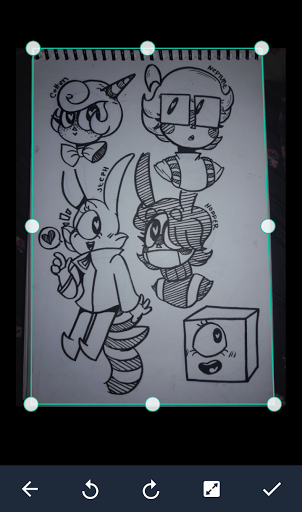
hello! I recently found this rad app called “CamScanner”, a mobile app for android and iOS
what does this app do? well, basically it imitates a scanner, so even if you don’t have one, you can take real cool pictures of your drawings!
for this to work, i suggest you take a picture of your entire paper / sketchbook / etc. The app will automatically crop your picture and come out with something like this:
(sometimes it wont be too accurate, but that can be easily fixed by moving the frame yourself)
once scanned, the app will make it so your drawing looks like this:
(the app will have some presets, so you might want to mess around with those. OR you can mess with the settings yourself to get a look you desire)
this can be really helpful if you plan to color your traditional piece on a computer, or something similar.
this can even work with colored drawing, if you’d like!
original:
edited with CamScanner:
if you mess with the settings yourself, i bet you could get the picture to look better, as i did this with the presets.
Hi Tumblr! Sorry for the erratic updates. I have been very busy, for secret reasons.
Soon a couple of my dear friends who have little or no experience of handling real firearms are going to be playing snipers at a new LARP game, so this week we’re going to study how real life rifle marksmen* move and shoot, and find ways to quickly emulate their skills in LARP.
This post is not about making you a better shot with functioning LARP firearm simulators like NERF, paintball or Airsoft weapons. The range on those weapons is so low that you can probably learn more by applying the principles of this post about LARP archery than from what I’m about to say here. This post is all about using real life techniques to provide body language and acting skills.
Photo by Oliver Facey, from Pioneers LARP. Kneeling or crouching supported, making good use of cover to steady the rifle.
1. GET LOW. NO, LOWER
A clean shot is a stable shot. The most stable rest you’re going to find for your rifle is the ground; an ideal marksmanship position puts an absolute minimum of the wobbly squishy stuff, i.e. your body, between your rifle and the rest. The best firing position is “prone” – lying on your front, elbows on the ground, rifle resting on the ground and supported firmly in place.
I love hearing people get enthusiastic about the SA80, particularly this excellent person. ‘Sharpshooter’ suggested as more gender-neutral alternative, but might share some of the same problems as ‘Sniper’.
Hey thanks! 😀 I love the SA-80 because it is a gorgeous heavy beautifully balanced lump of antiquated 5.56 beauty and also my bae ❤ ❤
I like “sharpshooter”! It’s a good gender neutral alternative to marksman – thank you. What would the skill suffix or noun be? Sharpshootership doesn’t roll off the tongue 😀






 Steel Phoenix Studios