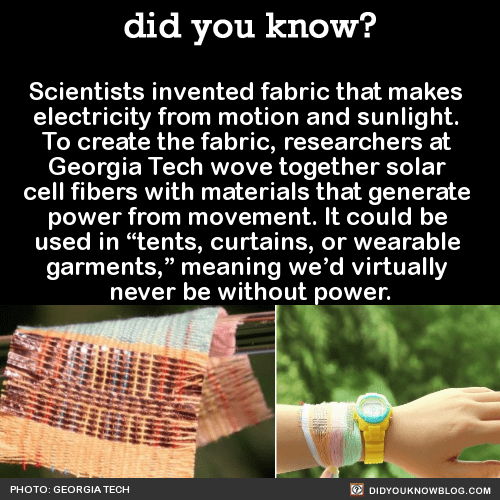
Scientists invented fabric that makes
electricity from motion and sunlight.
To create the fabric, researchers at
Georgia Tech wove together solar
cell fibers with materials that generate
power from movement. It could be
used in “tents, curtains, or wearable
garments,” meaning we’d virtually
never be without power. Source
Y’all are fucking idiots. Clean energy will NEVER be enough to replace the energy we have now. We’d have to tear down DOZENS of forests just to fit enough windmills and solar panels to get even a QUARTER (probably less, tbh) of the energy we can produce now.
Yeah, sure, when they’ve already calculated that a few square miles of panels in the empty ass Arizona desert could power the whole nation. But ok, fracking and the diminishing petroleum supply is worlds better.
Nevermind that windmills are often most efficient off the coast. There they take up no land, impact no trees, don’t pollute the water, and are conveniently located where winds are often strongest anyway.
And solar panels can literally be built into roofs of buildings and in empty areas like deserts. The sun strikes the Earth with the same amount of energy in an hour that our civilization uses in a year.
But yeah, it would be impossible for us to ever have enough energy from clean sources.
Durr hurr technology is bad and I would rather light shit on fire than have clean energy
I can also testify to the Arizona desert being empty ass. And the California desert. And the Nevada desert.
The fact that anyone can believe a limited amount of dinosaur oil is more plentiful and efficient than moving air or fucking sunlight is proof that entire populations can be completely brainwashed.
I’m here for the clean energy smackdown!
clean energy smackdown!
Costa Rica has been powering itself almost exclussively through hydroelectric, eolic and geotermic means for a while lmao all you need to do is not be a coward
What if oxygen is poisonous and it just takes 75-100 years to kill us?
My science teacher said he thinks that’s true actually
Yeah this is actually pretty much exactly what is going on. It’s why anti-oxidants are such a big deal. Bonus fact: oxygen oxidizes stuff in your cells or, in other words, it’s not toxic, just setting you on fire very very slowly.
What if there are aliens out there but they subsist on entirely different substances and they’re just scared as shit of us and our crazy ass hell planet? Once in a while some alien anthropologist type suggests checking out the people on this inhabited planet out towards the galaxy’s edge. The other aliens just look at the naive academic with horror. No!! We do not go to that world. That is where the DEATH BREATHERS live. They recreationally consume poisons and are more or less composed of biological fire. Their atmosphere is made of rocket fuel. We must leave the DEATH BREATHERS in peace. Do not go there. Do not.
I tend to always reblog posts about humans being terrifying weirdos to aliens.
okay but…that is actually what went down on earth about 2.5 billion years ago.
Earth was doing just fine with a mostly nitrogen/carbon dioxide atmosphere and everyone was happy to go on living in anaerobic bliss and then cyanobacteria suddenly hit the scene, altered the atmosphere composition so that there was a ton of oxygen gas and killed practically everything (97% or more of all species on earth).
We are literally descendants of the DEATH BREATHERS and cyanobacteria is our deadly mother.
The cyanobacteria holocaust is so big, it doesn’t even have a cool name; it’s just called “The Great Oxygenation Event”; the *second* most apocalyptic extinction event in our planet’s history is the one that’s called THE GREAT DYING (the Permian-Triassic event, about 252 million years ago).
This shit makes like the rock-throwing that wiped out the dinosaurs look like kindergarten.
OH HOW I LOVE THIS POST. It makes me so much happier about being alive. I AM BURNING VERY SLOWLY. *hugs it*
it was really heartening to learn that the purpose of creating such a thick uterine lining during the menstrual period was to prevent the implantation of embryos rather than encourage them, and that our uterus is basically flushing out anything it deems unworthy during the period itself rather than “punishing” us for not being pregnant (which is how it’s usually framed). it’s almost as if your female body is more concerned with the protection and continuation of itself rather than being used as a procreative vessel.
the fact that we’ve come to accept the idea that our reproductive organs are punishing us for not being continuously pregnant is proof of how deeply patriarchal brainwashing has convinced women that we are nothing but broodmares for ‘their’ children.
We’re set to launch ICESat-2, our most advanced laser instrument of its kind, into orbit around Earth on Sept. 15. The Ice, Cloud and land Elevation Satellite-2 will make critical observations of how ice sheets, glaciers and sea ice are changing over time, helping us better understand how those changes affect people where they live. Here’s 10 numbers to know about this mission:
One Space Laser
There’s only one scientific instrument on ICESat-2, but it’s a marvel. The Advanced Topographic Laser Altimeter System, or ATLAS, measures height by precisely timing how long it takes individual photons of light from a laser to leave the satellite, bounce off Earth, and return to ICESat-2. Hundreds of people at our Goddard Space Flight Center worked to build this smart-car-sized instrument to exacting requirements so that scientists can measure minute changes in our planet’s ice.
Sea ice is seen in front of Apusiaajik Glacier in Greenland. Credit: NASA/JPL-Caltech/Jim Round
Two Types of Ice
Not all ice is the same. Land ice, like the ice sheets in Greenland and Antarctica, or glaciers dotting the Himalayas, builds up as snow falls over centuries and forms compacted layers. When it melts, it can flow into the ocean and raise sea level. Sea ice, on the other hand, forms when ocean water freezes. It can last for years, or a single winter. When sea ice disappears, there is no effect on sea level (think of a melting ice cube in your drink), but it can change climate and weather patterns far beyond the poles.
3-Dimensional Earth
ICESat-2 will measure elevation to see how much glaciers, sea ice and ice sheets are rising or falling. Our fleet of satellites collect detailed images of our planet that show changes to features like ice sheets and forests, and with ICESat-2’s data, scientists can add the third dimension – height – to those portraits of Earth.
Four Seasons, Four Measurements
ICESat-2’s orbit will make 1,387 unique ground tracks around Earth in 91 days – and then start the same ground pattern again at the beginning. This allows the satellite to measure the same ground tracks four times a year and scientists to see how glaciers and other frozen features change with the seasons – including over winter.
532 Nanometer Wavelength
The ATLAS instrument will measure ice with a laser that shines at 532 nanometers – a bright green on the visible spectrum. When these laser photons return to the satellite, they pass through a series of filters that block any light that’s not exactly at this wavelength. This helps the instrument from being swamped with all the other shades of sunlight naturally reflected from Earth.
Six Laser Beams
While the first ICESat satellite (2003-2009) measured ice with a single laser beam, ICESat-2 splits its laser light into six beams – the better to cover more ground (or ice). The arrangement of the beams into three pairs will also allow scientists to assess the slope of the surface they’re measuring.
Seven Kilometers Per Second
ICESat-2 will zoom above the planet at 7 km per second (4.3 miles per second), completing an orbit around Earth in 90 minutes. The orbits have been set to converge at the 88-degree latitude lines around the poles, to focus the data coverage in the region where scientists expect to see the most change.
800-Picosecond Precision
All of those height measurements come from timing the individual laser photons on their 600-mile roundtrip between the satellite and Earth’s surface – a journey that is timed to within 800 picoseconds. That’s a precision of nearly a billionth of a second. Our engineers had to custom build a stopwatch-like device, because no existing timers fit the strict requirements.
Nine Years of Operation IceBridge
As ICESat-2 measures the poles, it adds to our record of ice heights that started with the first ICESat and continued with Operation IceBridge, an airborne mission that has been flying over the Arctic and Antarctic for nine years. The campaign, which bridges the gap between the two satellite missions, has flown since 2009, taking height measurements and documenting the changing ice.
10,000 Pulses a Second
ICESat-2’s laser will fire 10,000 times in one second. The original ICESat fired 40 times a second. More pulses mean more height data. If ICESat-2 flew over a football field, it would take 130 measurements between end zones; its predecessor, on the other hand, would have taken one measurement in each end zone.
And One Bonus Number: 300 Trillion
Each laser pulse ICESat-2 fires contains about 300 trillion photons! Again, the laser instrument is so precise that it can time how long it takes individual photons to return to the satellite to within one billionth of a second.
Not Yelling At Children is Better Than Yelling At Children, More At 11
“No shit” studies like this get funded because a lot of people still believe that “strict parenting” (i.e. screaming at your kid, using physical punishment) will “fix” their kids’ ADHD symptoms. I only did child therapy for about a year and a huge contributing factor to my burnout was watching parent after parent, no matter how well intentioned, fall into the socially ingrained trap of blaming their kids’ behavior on “lack of respect” or “laziness” or “manipulation.” They had to be constantly reminded that their children’s symptoms were not actually about them. Every time they forgot, they’d slip back into the same parenting strategies that, frankly, landed their family in crisis stabilization therapy in the first place.
The thing is, the success of any given parenting strategy can only be seen over time. Like any behavior modification, you’ll only get valid results if you’re consistent. If you’re calm with a kid most of the time but every now and then you beat them, being calm is going to seem like it “doesn’t work” because your kid knows the other shoe could drop at any second. They’re still in fight-or-flight mode waiting to see what you’ll do next, and it’s almost impossible to make well-reasoned choices when your amygdala is in charge. It can take a long damn time to build a communication pattern in which your kid trusts that you’ll stay calm. Most parents give it about a week and then declare that their kid must just be different or worse than other kids, or that the therapist/caseworker doesn’t understand what its really like.
Studies like this are so important, because it gives us something to point to when parents feel unsure of what to do with a child whose moods and needs aren’t easy for them to understand. I guarantee that for every study like this saying what “we all know,” these parents are exposed to 50 idiots saying they just need to whip some respect into their kids.
Not to mention that a) C-PTSD makes ADHD symptoms worse and b) a lot of people with ADHD also HAVE C-PTSD, because people were abusive and blamed them for being “lazy”/”stupid”/etc
“But Maria explained and painted their life cycle. Their metamorphosis from caterpillar to chrysalis to butterfly. She not only explained that process, she showed which plant species each butterfly species was dependent upon. This book revolutionised the study of insects in Europe. But it also helped Maria raise the funds to embark upon a journey to study the more exotic creatures that she knew she would find in the tropical regions of the Dutch empire.”
David Olusoga, Civilisations, ep. 6 ‘First Contact’ (BBC 2018)




















 Steel Phoenix Studios