A store-bought bag of topsoil, a roll of landscaping fabric, or a bag of cedar chips doesn’t go very far if you have a large garden or a very limited budget. Here are some ways to create the materials you need for a beautiful, organic, productive garden, by both re-directing household waste, and foraging in your local area. I use a lot of these tricks in my garden to make it almost completely free for me to continue growing new things, and expanding the workable area every year!
For soil
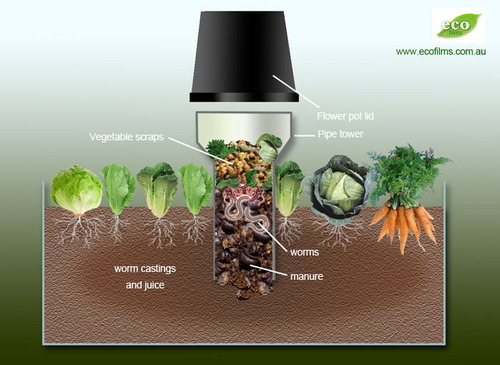
Save your food scraps to create a rich compost for growing veggies and amending your soil. There are numerous options for every size of dwelling and yard. Small space solutions such as Bokashi and vermicompost work indoors and don’t produce bad smells, so you can keep them underneath the sink.Worm towers, compost heaps, and outdoor compost binsare a great solution if you have more space. The more you add, the more rich, nutritious material you can make for your garden. I like composting because it means I don’t have gross smelly garbage bags to deal with, because food waste is diverted. It seems like a lot of work at first, but it actually saves time, money, and transportation.
There are three things that are essential for plant growth. These are nitrogen for leaves and vegetation (N), phosphorus for roots and shoots (P), and potassium for water movement, flowering, and fruiting (K). Commercial fertilisers will give the relative concentrations of each of these compounds with and “NPK” rating. Plants like tomatoes also need calcium to produce healthy fruit. You can create amendments for your garden and soil at home so that you do not have to purchase fertiliser.
Human urine contains 12% nitrogen, and it’s sterile. Dilute before adding directly to plants.
Legumes such as beans, clover, peanuts, and alfalfa fix inorganic nitrogen into the soil with mycorrhizal organisms and nodules on their root systems. Plant these crops every few years in rotation with others to renew the soil organically.
For phosphorus
Human urine is also a great source of phosphorous and trace amounts of potassium.
Many plants are particular about what the soil pH should be.
To make soil more acidic: add oak leaves, pine needles, leaf mulch, urine, coffee grounds or sphagnum.
To make soil more alkaline: add wood ash, shell, or bone.
Mulch
Mulch is decomposing organic matter that adds nutrition to the soil, while simultaneously keeping out weed growth and retaining moisture. It also attracts worms, fungi and other beneficial creatures to your soil. Free sources of mulch include:
Leaves
Garden waste
Grass clippings
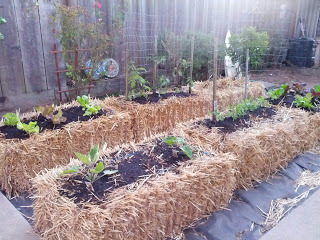
Straw (often straw bales are given away after being used for decoration in the fall. You can also plant vegetables directly in straw bales using a technique called straw bale gardening).
Wood chips (if you can borrow a wood chipper after you’ve collected some wood you can have attractive wood mulch for free)
When mulch isn’t enough to keep the weeds down, many people opt for landscaping fabric. It can be quite expensive and inorganic-looking. Free solutions that both attract worms and can be replaced in small segments as they break down include:
Newspaper*
Cardboard*
Egg cartons*
Printer paper, looseleaf, etc. in thick layers*
*try to make sure you are using paper that has vegetable-based dyes, so you aren’t leeching toxins into the soil.
Soil density/drainage
If your soil is compacted and you have plants that require low levels of water, or excellent drainage, add sand. I don’t recommend stealing it from the beach, but ask around and you’d be surprised at how easy it is to get for free. Sawdust also improves drainage. Adding organic matter and mulch encourages worms, who also till and aerate compacted soil.
If the area still needs drainage, dig a hole and fill it with bricks or rocks to create a “dry well”
For drainage in pots, add crushed bricks,terra cotta pot fragments, packing peanuts, small stones, marbles, orsand to the bottom under the soil layer. I find these in construction sites, on craigslist, or at flea markets.
Pots and growing containers
If you have space, raised beds are a great no-dig way to establish growing space. If you are pressed for space (like working on a balcony) there are many cheap or free options for container gardens.
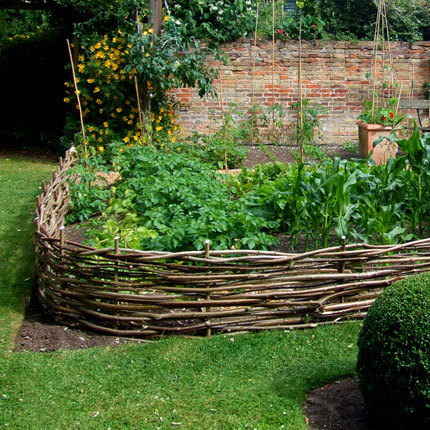
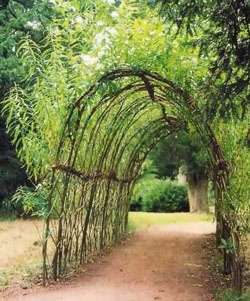
Creating raised beds allows you to build up the soil without digging. Free ways to do this include using rocks or lumber (like my DIY “lasagna garden” made with the sheet composting technique), using the “wattle“ method with sticks and posts you have found, using discarded straw bales, old bricks,paving stones,cinder blocks or really anything else you have lying around.
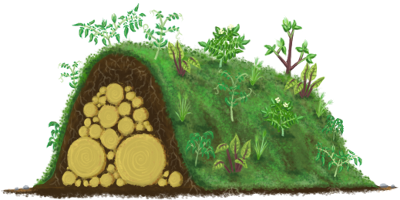
Hugelkutur raised beds, which fix carbon and provide drainage, can be made by stacking sticks and untreated wood, and then piling soil or compost over it. (Thanks milos-garden)
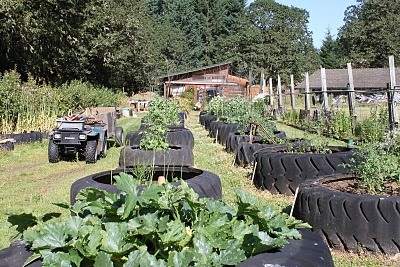
Rubber tire gardens retain heat in the night and allow for great drainage. They can also be painted in fun ways.
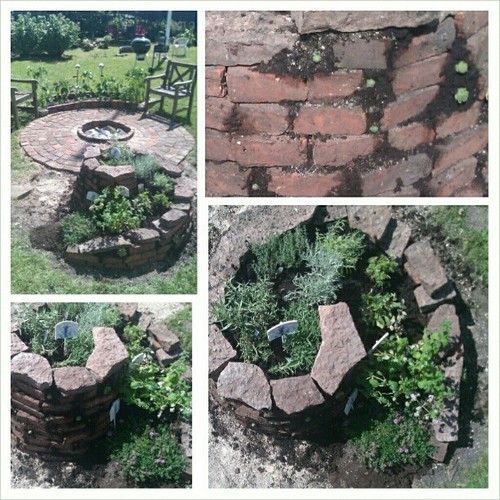
Herb spirals (here is mine: 1, 2, 3) can be built with stones, bricks, and other found materials.
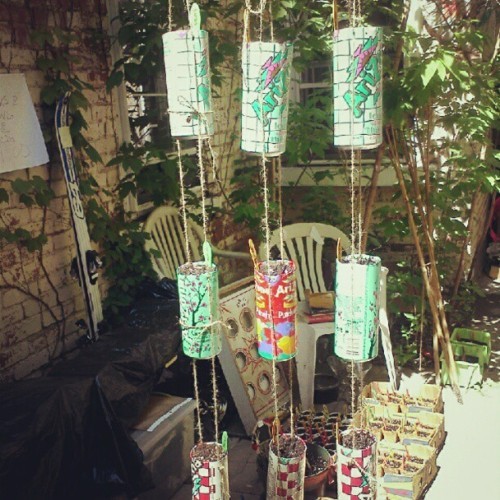
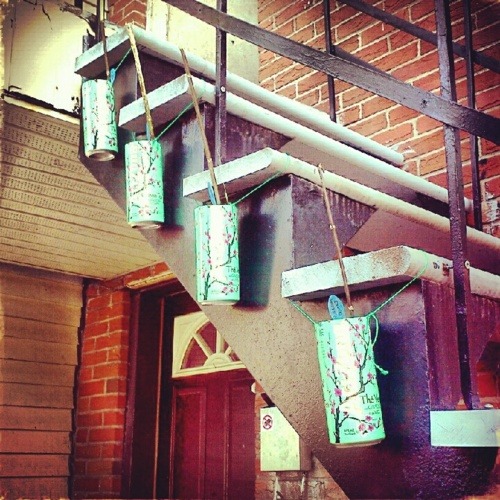
I often use old cooking pots, barbecues, teapots, or other found objects as planters.
If you can track down peat moss, cement, and vermiculite, you can make an easy Hypertufa planter in whatever shape you would like, provided you have a form in which it can dry.
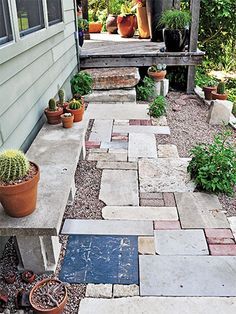
Paving often requires a foundation of sand or another stable and well-drained substrate, and a covering of stones, bricks, or other weatherproof elements. Slowly collect stones over time, or free paving stone fragments to create a mosaic-type walkway. Often people give these things away on craigslist. I made a patio and fireplace out of free salvaged bricks, for example.
Save seeds from foods you like from the grocery store: consider growing peanuts, ginger, garlic, peppers, or a walnut tree: all of these and more can be planted from store-bought produce.
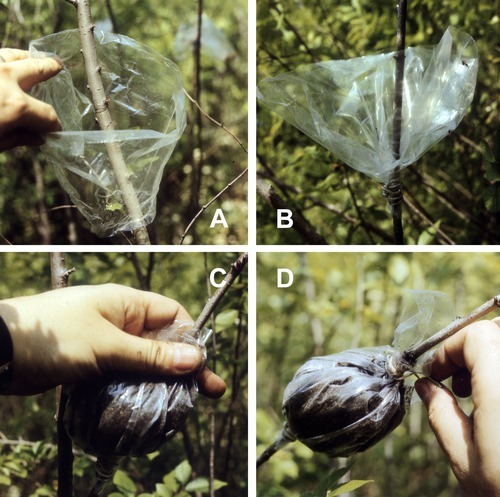
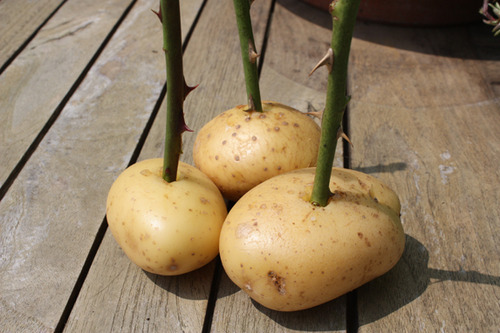
Learn to take cuttings. There is a tonne of info on the web about basic cutting propagation, layering, (like I do with rhododendrons) air layering, and numerous other techniques to take clones of plants you like. This saves going to a nursery and shelling out big bucks for all the variety you want.
For cuttings, willow tea and honey are great rooting hormones/antiseptics/anti-fungal agents, which can save you $40 if you were thinking of buying commercial rooting hormone.
I hope this helps you build your garden outside of the usual capitalist channels! It can be a cheap or free hobby if you are willing to think outside the box, and maybe put up with things that don’t look as clean or crisp as a hardware store catalogue.
If you have any further ideas, please add them! The more information the better.
Drainage for pots can also be achieved with styrofoam, pine cones, bark, twigs and branches, etc. We’ve used mostly sweetgum fruit in our last few pots and had good results with it!
P I S S O N Y O U R P L A N T S
but actually a lot of this is super sound advice and I want to try a lot of it
I’m watching Doomsday Preppers. These people have an unbelievably bleak view of humanity, like, I’m just saying my family survived the complete disintegration of Lebanese civil society without shanking their neighbours for water or stockpiling hand grenades.
If your reaction to a foreseen future economic collapse is to set traps and stockpile guns to kill your neighbours who want some of your huge food stock, you are broken and I have no idea how to fix you.
^^^ The ability to cooperate with others is an evolutionary advantage
My husband and I used to think we were “preppers,” until we discovered that for most people, “prepping” means hoarding guns and ammo and bear traps and nonsense like that, and planning to turn on other survivors in the event of some society-destroying cataclysm. And here we were geeking out about woodworking and first aid and sustainable edibles foraging and water purification and subsistence farming and how best to set up an agrarian community to maximize square footage.
Turns out we’re just prepared solarpunks. I think I’m fine with that. Miss me with the toxic, gun-crazy, neighbor-hating Prepper culture and join me in my garden of native wild edibles.
I’m not sure how all of the logistics would work (I’m more of a sociology guy than a STEM guy), but I don’t see why a colder climate wouldn’t be able to take advantage of renewable energy sources – geothermal and perfected solar technology and such.
Aesthetically, you’d probably end up with something very similar to the “Northern Lights glass igloos” in Finland:
Maybe connect all the igloos with a tunnel/tube system and have them all link up to a big hub at the center. Maybe the hub has advanced solar panels and sits on a geothermal hot spot, and the energy accumulated there could power the surrounding homes and buildings.
People can and should add to this, because my winter solarpunk imagination is a tad limited.
One thing to remember about northern climes is that while winter days are brief and dark, summer days are very, very long; in my part of the world, nights at the height of summer last something like six hours. The issue comes with the winter months, when the sun all but disappears and the emphasis turns to keeping out the cold and lighting up the dark; geothermal is an excellent solution, but wind power is also a viable option that’s fairly popular. Additionally, a concept exists wherein one uses walls as heat-sinks, absorbing sunlight and heat during brief winter days and using that to keep a structure warm through the night, combined with a broad roof to keep the sun off of it in the summer months when the sun hangs higher in the sky; scale it up a bit, and one could imagine entire south-facing housing complexes benefiting from this method.
Venturing into a more sci-fi sorta realm, one could take the most advantage of geothermal by constructing subterranean cities that siphon heat from the depths of the Earth’s crust, or take advantage of long summer days by setting up solar heat-sinks that store huge amounts of energy all summer and slowly release it through the winter. On a smaller scale, combine OP’s transparent igloos with dark-colored spheres filled with something with a high heat capacity (even plain water would do) and you get something that takes up heat through the day and radiates it all night, a low-tech, solar-powered space heater (though combine this with ultra-black nano-compounds and glass that turns opaque at night to keep the infrared radiation inside and it becomes a bit less low-tech).
Solar is less of an option in cold climates – they’re cold because the solar energy density is lower. Geothermal and wind are the way to go.
Then there is tidal energy. Solarpunk doesn’t have to be literal solar
There’s been a big increase in the popularity of mudbrick, compressed earth, and stone housing, which is naturally insulating (both heat and cold) and is super economical. They’ve been doing it for millennia – check out the turf houses of Scandinavia and the underground houses of Tunisia (famously used as the Lars Homestead in Star Wars).
Also – I can’t find the link for it, but – there’s an aircon system using a series of liquid-filled coils buried in the ground (3-5m deep iirc), you can have natural heat exchange (warmth in the winter and cold in the summer), and all you need to power is the pump.
Humans adapting themselves to nature rather than forcing other species to adapt to us. This is what we must do in the Anthropocene. Trees are the most important three dimensional structures of many ecosystems, and they are the central design features of most permaculture gardens. They provide many products and services to other species, from housing to food (acorns, insects, pollen), shade and shelter from the wind. We ought to respect their importance.
THIS IS WHAT LIFE SHOULD BE AM SO FUCKING ABOUT THIS
OH MY GOD. READ THE DINOTOPIA BOOKS. They have beautiful illustrations and amazing concepts and the worldbuilding is STUNNING and they thought of everything. Also the characters are Fantastic. I swear to God kid-me took these books out at the library Every Time they were available. My love of them knows no bounds.
But yes, they are solarpunk and just generally great.









 Steel Phoenix Studios

