i’ve stopped trash talking comic sans after learning the font is actually one of the only dyslexia-friendly fonts that come standard with most computers and i advocate for others doing the same
In the event that you would like to continue hating Comic Sans, other dyslexia-friendly alternatives include Arial, Verdana, Tahoma, Century Gothic and Trebuchet.
thank
Random fact: Verdana is one of the few fonts which was specifically designed to be as easy to read as possible, even at smaller type sizes. It was designed this way for use on screen, but the same principles apply in print too. This is part of why some Universities use Verdana as their default font for documents.
“In the event that you would like to continue hating Comic Sans” is one of the best things I’ve ever read on this website
Century Gothic and Trebuchet are both quite handsome typefaces.
I’m partial to Century Gothic as well. It’s serif, but not boring.
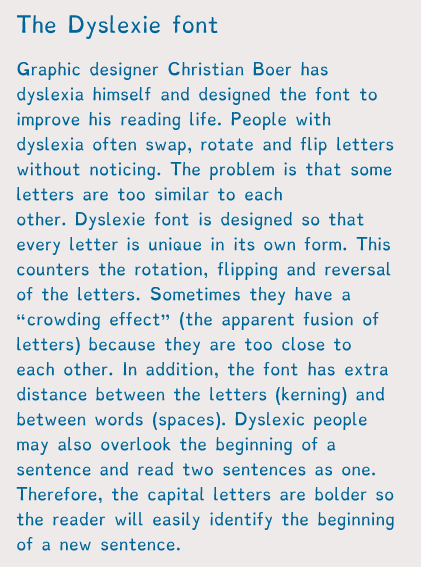
There’s also a dyslexic font designed especially for dyslexic people to read.
You can install on your tablets, laptops and browers etc, so not only can you change things like documents into it, you can change websites into that font as well!
I’m sure you’re bright enough to do a google search, but since I’m dumb enough to forget to post a link, here it is. Better late than never
I default to arial for this reason, but I will now be defaulting to verdana or dyslexie. nice.
I don’t think I have dyslexia but that dyslexie font was the easiest fucking thing to read ever. Books should be written in that shit.
ALSO!!!
For computer reading, when you mix up lines of text, there’s a web browser app called Beeline Reader. It looks like this
The colors are also customizable, to an extent and while I don’t have dyslexia, I have adhd which makes reading large amounts of text harder and this helps A LOT.
I have literally never been able to read an entire paragraph without having to go back and figure out which line I’ve missed oh my god
BeeReader is actually going to change my life today
my mum sent me this vid which demonstrates how to use a (usb) charger when ur power goes out, using a car usb plugin, charging cable,a pen spring, and a 9V battery
life tip whatever dumb ass name you get siri to call you is what your iphone automatically signs your emails as. i have been applying to jobs for 2 months as queef.
My friend shared this. I shared this subreddit. He stands corrected.
Not to mention, what are you going to recommend to them instead? Our options are limited to: Pretty crappy and subject to a lot of hacks, but affordable and user friendly (Windows). Way too expensive, insanely proprietary, not user friendly, and really only useful to artists because of all the free editing software (Mac). Or, so incredibly hard to install and set up that you almost have to be an IT person to even install it, but it’s free, stable, and next to no viruses are written to attack it (Linux and possibly others out there).
dude, the only people who have conversations where they randomly recommend operating systems to each other are Linux wonks
Nah, anyone in the tech industry has those conversations.
Linux has been made Really Easy in the last five years, it’s not scary any more! I did a fresh install of Kubuntu in about twenty minutes and it was like… three tickboxes and a few options. Linux Mint is also super easy, and has literally everything you need out of the box.
Today in the modern world we take freezers, and the frozen results of freezers for granted. But in ancient times, cold drinks, frozen desserts, and chilled tropical cocktails were a luxury unknown to most people. However the idea of artificially freezing goods is nothing new. As far back as 400 BC, the ancient Persians built special freezers called yakhchals. Yakhchals were large buildings used for storage of ice and foodstuffs during the hot Persian summers. Typically they were around 60 feet tall, and had a large subterranean storage space dug out from under it. The Yakhchal itself was made from a special type of mud clay called sarooj which was composed of clay, sand, lime, goat hair, egg whites, and ash mixed in a special proportion which made it extremely resistant to heat transfer. In other words the inside stayed cool, while heat from the outside was prevented from entering the building because of the thick insulated walls. This combined with the subterranean storage ensured that whatever goods were stored in the pit stayed cool, as temperatures below ground level are usually around the 60 to 65 degree Fahrenheit range. However, these designs were not what made a yakhchal a freezer. There was one other brilliant design feature which ensured that the yakhchal would stay frosty all year long.
At the top of the dome was a small hole, or series of small holes called windcatchers. Typically windcatchers were pointed in the direction of the prevailing winds. Due to its conical shape there was always a negative pressure gradient inside the yakhchal. According to Bernoulli’s Law air flow at a high pressure will always move toward areas of low pressure. Thus air from the outside was constantly flowing through the yakhchal. In addition, according to Venturi’s Principal, whenever air flows through a small hole, the smaller the hole, the greater the speed of the flow. The small hole, or series of holes of the yakhchal ensured that air passed into it at great flows. What resulted was a great amount of outside air entering into the yakhchal at high speeds. While the air itself wasn’t cool, the flows at which it was being entrained into the yakhchal created temperatures that were below freezing. Typically the windcatchers were cut in such a way that the incoming jet of air would be directed onto the storage pit.
The ancient Persians primarily used their yakhchals for storing ice and foodstuffs. During the summer, Persian nobles often enjoyed a frozen treat called faloodeh (pictured above), which is made from thin noodles with syrup made from sugar and rose water, then flavored with lemon, lime, fruits, almond, pistachio, and other flavorings. Due to the Persian’s freezing technology, faloodeh (which is still popular today) goes down in history as one of the first frozen desserts. The practice of building and using yakhchals continued up to the 20th century, when they were eventually replaced with modern freezers and refrigerators.














 Steel Phoenix Studios