old people really need to learn how to text accurately to the mood they’re trying to represent like my boss texted me wondering when my semester is over so she can start scheduling me more hours and i was like my finals are done the 15th! And she texts back “Yay for you….” how the fuck am i supposed to interpret that besides passive aggressive
Someone needs to do a linguistic study on people over 50 and how they use the ellipsis. It’s FASCINATING. I never know the mood they’re trying to convey.
I actually thought for a long time that texting just made my mother cranky. But then I watched my sister send her a funny text, and my mother was laughing her ass off. But her actual texted response?
“Ha… right.”
Like, she had actual goddamn tears in her eyes, and that was what she considered an appropriate reply to the joke.I just marvelled for a minute like ‘what the actual hell?’ and eventually asked my mom a few questions. I didn’t want to make her feel defensive or self-conscious or anything, it just kind of blew my mind, and I wanted to know what she was thinking.
Turns out that she’s using the ellipsis the same way I would use a dash, and also to create ‘more space between words’ because it ‘just looks better to her’. Also, that I tend to perceive an ellipsis as an innate ‘downswing’, sort of like the opposite of the upswing you get when you ask a question, but she doesn’t. And that she never uses exclamation marks, because all her teachers basically drilled it into her that exclamation marks were horrible things that made you sound stupid and/or aggressive.
So whereas I might sent a response that looked something like:
“Yay! That sounds great – where are we meeting?”
My mother, whilst meaning the exact same thing, would go:
‘Yay. That sounds great… where are we meeting?”
And when I look at both of those texts, mine reads like ‘happy/approval’ to my eye, whereas my mother’s looks flat. Positive phrasing delivered in a completely flat tone of voice is almost always sarcastic when spoken aloud, so written down, it looks sarcastic or passive-aggressive.
On the reverse, my mother thinks my texts look, in her words, ‘ditzy’ and ‘loud’. She actually expressed confusion, because she knows I write and she thinks that I write well when I’m constructing prose, and she, apparently, could never understand why I ‘wrote like an airhead who never learned proper English’ in all my texts. It led to an interesting discussion on conversational text. Texting and text-based chatting are, relatively, still pretty new, and my mother’s generation by and large didn’t grow up writing things down in real-time conversations. The closest equivalent would be passing notes in class, and that almost never went on for as long as a text conversation might. But letters had been largely supplanted by telephones at that point, so ‘conversational writing’ was not a thing she had to master.
So whereas people around my age or younger tend to text like we’re scripting our own dialogue and need to convey the right intonations, my mom writes her texts like she’s expecting her Eighth grade English teacher to come and mark them in red pen. She has learned that proper punctuation and mistakes are more acceptable, but when she considers putting effort into how she’s writing, it’s always the lines of making it more formal or technically correct, and not along the lines of ‘how would this sound if you said it out loud?’
So the other night during D&D, I had the sudden thoughts that:
1) Binary files are 1s and 0s
2) Knitting has knit stitches and purl stitches
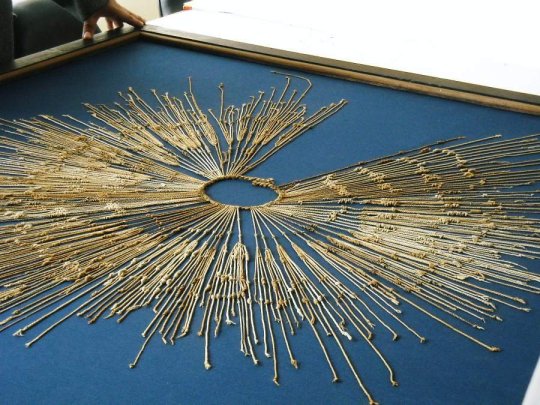
You could represent binary data in knitting, as a pattern of knits and purls…
You can knit Doom.
However, after crunching some more numbers:
The compressed Doom installer binary is 2.93 MB. Assuming you are using sock weight yarn, with 7 stitches per inch, results in knitted doom being…
3322 square feet
Factoring it out…302 people, each knitting a relatively reasonable 11 square feet, could knit Doom.
Hi fun fact!!
The idea of a “binary code” was originally developed in the textile industry in pretty much this exact form. Remember punch cards? Probably not! They were a precursor to the floppy disc, and were used to store information in the same sort of binary code that we still use:
Here’s Mary Jackson (c.late 1950s) at a computer. If you look closely in the yellow box, you’ll see a stack of blank punch cards that she will use to store her calculations.
This is what a card might look like once punched. Note that the written numbers on the card are for human reference, and not understood by the computer.
But what does it have to do with textiles? Almost exactly what OP suggested. Now even though machine knitting is old as balls, I feel that there are few people outside of the industry or craft communities who have ever seen a knitting machine.
Here’s a flatbed knitting machine (as opposed to a round or tube machine), which honestly looks pretty damn similar to the ones that were first invented in the sixteenth century, and here’s a nice little diagram explaining how it works:
But what if you don’t just want a plain stocking stitch sweater? What if you want a multi-color design, or lace, or the like? You can quite easily add in another color and integrate it into your design, but for, say, a consistent intarsia (two-color repeating pattern), human error is too likely. Plus, it takes too long for a knitter in an industrial setting. This is where the binary comes in!
Here’s an intarsia swatch I made in my knitwear class last year. As you can see, the front of the swatch is the inverse of the back. When knitting this, I put a punch card in the reader,
and as you can see, the holes (or 0′s) told the machine not to knit the ground color (1′s) and the machine was set up in such a way that the second color would come through when the first color was told not to knit.
tl;dr the textiles industry is more important than people give it credit for, and I would suggest using a machine if you were going to try to knit almost 3 megabytes of information.
It goes beyond this. Every computer out there has memory. The kind of memory you might call RAM. The earliest kind of memory was magnetic core memory. It looked like this:
Wires going through magnets. This is how all of the important early digital computers stored information temporarily. Each magnetic core could store a single bit – a 0 or a 1. Here’s a picture of a variation of this, called rope core memory, from one NASA’s Apollo guidance computers:
You may think this looks incredibly handmade, and that’s because it is. But these are also extreme close-ups. Here’s the scale of the individual cores:
The only people who had the skills necessary to thread all of these cores precisely enough were textile and garment workers. Little old ladies would literally thread the wires by hand.
And thanks to them, we were able to land on the moon. This is also why memory in early computers was so expensive. It had to be hand-crafted, and took a lot of time.
Don’t underestimate the impact craft has had on our culture
Poliomyelitis is a highly contagious disease that can cause paralysis
of legs, arms, and respiratory muscles. “The polio virus is a silver
bullet designed to kill specific parts of the brain,” Richard Bruno, a
clinical psychophysiologist, and director of the International Centre
for Polio Education said. “But parents today have no idea what polio was
like, so it’s hard to convince somebody that lives are at risk if they
don’t vaccinate.”
When Lillard was a child, polio was every
parent’s worst nightmare. The worst polio outbreak year in US history
took place in 1952, a year before Lillard was infected. There were about
58,000 reported cases. Out of all the cases, 21,269 were paralyzed and
3,145 died. “They closed theaters, swimming pools, families would keep
their kids away from other kids because of the fear of transmission,”
Bruno said.
Children under the age of five are especially susceptible. In the 1940s
and 1950s, hospitals across the country were filled with rows of iron
lungs that kept victims alive. Lillard recalls being in rooms packed
with metal tubes—especially when there were storms and all the men,
women, adults, and children would be moved to the same room so nurses
could manually operate the iron lungs if the power went out. “The period
of time that it took the nurse to get out of the chair, it seemed like
forever because you weren’t breathing,” Lillard said. “You just laid
there and you could feel your heart beating and it was just terrifying.
The only noise that you can make when you can’t breathe is clicking your
tongue. And that whole dark room just sounded like a big room full of
chickens just cluck-cluck-clucking. All the nurses were saying, ‘Just a
second, you’ll be breathing in just a second.’”
It’s hard to come up with ideas for Halloween costumes, especially when it seems like all the good ones are taken. And don’t you hate showing up at a party only to discover that there’s *another* pajama cardinalfish?
The most popular submitted costumes are the classics (42 witches, 32 ghosts, 30 pirates, 22 Batmans, 21 cats (30 incl sexy cats), 19 vampires, and 17 each of pumpkins and sexy nurses). There are about 300 costumes with “sexy” in their names; some of the most eyebrow-raising include sexy anglerfish, sexy Dumbledore, sexy golden pheasant, sexy eyeball, sexy Mothra, Sexy poop emoji, Sexy Darth Vader, Sexy Ben Franklin, Sexy TARDIS, Sexy Cookie Monster, and Sexy DVORAK keyboard. In the “technical challenge” department, we have costumes like Invisible Pink Unicorn, Whale-frog, Glow Cloud, Lake Michigan, Toaster Oven, and Garnet.
All this is to say that humans are very creative, and this task was going to be tricky for a neural network. The sensible approach would be to try to use a neural network that actually knows what the words mean – there are such things, trained by reading, for example, all of Google News and figuring out which words are used in similar ways. There’s a fun demo of this here. It doesn’t have an entry for “Sexy_Gandalf” but for “sexy” it suggests “saucy” and “sassy”, and for “Gandalf” it suggests “Frodo”, “Gollum”, and “Voldemort”, so you could use this approach to go from “Sexy Gandalf” to “Sassy Voldemort”.
I wanted something a bit weirder. So, I used a neural network that learns words from scratch, letter by letter, with no knowledge of their meaning, an open-source char-rnn neural network written in Torch. I simply dumped the 4500 Halloween costumes on it, and told the neural network to figure it out.
Early in the training process, I decided to check in to see how it was doing.
Sexy sexy Dombie Sexy Cat Sexy A stare Rowan Sexy RoR A the Rog Sexy Cot Sexy Purbie Lampire Poth Rat Sexy Por Man The Wombue Pombie Con A A Cat The Ran Spean Sexy Sexy Pon Sexy Dander Sexy Cat The Gull Wot Sexy Pot Hot
In retrospect, I should have expected this. With a dataset this varied, the words the neural network learns first are the most common ones.
I checked in a little later, and things had improved somewhat. (Omitted: numerous repetitions of “sexy nurse”). Still the only thing that makes sense is the word Sexy.
Sexy The Carding Ging Farbat of the Cower Sexy The Hirler A costume Sexy Menus Sexy Sure Frankenstein’s Denter A cardian of the Pirate Ging butter Sexy the Girl Pirate
By the time I checked on the neural network again, it was not only better, but astoundingly good. I hadn’t expected this. But the neural network had found its niche: costume mashups. These are actually comprehensible, if a bit hard to explain:
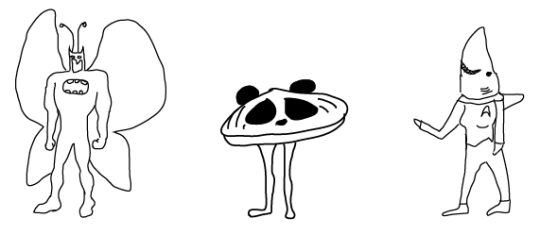
Punk Tree Disco Monster Spartan Gandalf Starfleet Shark A masked box Martian Devil Panda Clam Potato man Shark Cow Space Batman The shark knight Snape Scarecrow Gandalf the Good Witch Professor Panda Strawberry shark Vampire big bird Samurai Angel lady Garbage Pirate firefighter Fairy Batman
Other costumes were still a bit more random.
Aldonald the Goddess of the Chicken Celery Blue Frankenstein Dancing Bellyfish Dragon of Liberty A shark princess Statue of Witch Cupcake pants Bird Scientist Giant Two butter The Twin Spider Mermaid The Game of Nightmare Lightbare Share Bat The Rocky Monster Mario lander Spork Sand Statue of pizza The Spiding hood A card Convention Sailor Potter Shower Witch The Little Pond Spice of pokeman Bill of Liberty A spock Count Drunk Doll of Princess Petty fairy Pumpkin picard Statue of the Spice of the underworker
It still was fond of using made-up words, though. You’d be the only one at the party dressed as whatever these are.
Sparra A masked scorby-babbersy Scormboor Magic an of the foand tood-computer A barban The Gumbkin Scorbs Monster A cat loory Duck The Barboon Flatue doctor Sparrow Plapper Grankenstein The Spongebog Minional marty clown Count Vorror Rairol Mencoon A neaving hold Sexy Avical Ster of a balana Aly Huntle starber pirate
And it ended up producing a few like this.
Sports costume Sexy scare costume General Scare construct
The reason? Apparently someone decided to help out by entering an entire costume store’s inventory. (”What are you supposed to be?” “Oh, I’m Mens Deluxe IT Costume – Size Standard.”)
There were also some like this:
Rink Rater Ginsburg A winged boxer Ginsburg Bed ridingh in a box Buther Ginsburg Skeleton Ginsburg Zombie Fire Cith Bader Ginsburg
Because someone had entered about 50 variations on Ruth Bader Ginsberg puns (Ruth Tater Ginsberg, Sleuth Bader Ginsber, Rock Paper Ginsberg).
It invented some awesome new superheroes/supervillains.
Glow Wonder Woman The Bunnizer Ladybog Light man Bearley Quinn Glad woman robot Werewolf super Pun Super of a bog Space Pants Barfer buster pirate Skull Skywolk lady Skynation the Goddess Fred of Lizard
And oh, the sexy costumes. Hundreds of sexy costumes, yet it never quite got the hang of it.
Sexy Scare Sexy the Pumpkin Saxy Pumpkins Sexy the Pirate Sexy Pumpkin Pirate Sexy Gumb Man Sexy barber Sexy Gargles Sexy humblebee Sexy The Gate Sexy Lamp Sexy Ducty monster Sexy conchpaper Sexy the Bumble Sexy the Super bass Pretty zombie Space Suit sexy Drangers Sexy the Spock
You bet there are bonus names – and oh please go read them because they are so good and it was so hard to decide which ones to fit into the main article. Includes the poop jokes. You’re welcome.
Some of you are reblogging because you think its funny that programmers would talk to ducks. I’m reblogging because I think its funny picturing a programmer explaining their code, realizing what they did when they explain the bad code, then grabbing the strangling the duck while yelling “WHY WAS THE FIX THAT SIMPLE!? AM I GOING BLIND!”
AS A PROGRAMMER I CAN TELL YOU THAT THIS IS EXACTLY WHAT YOU FUCKING DO WE HAD TO BAN THE DUCKS FROM MY CLASSES BECAUSE EVERYONE WOULD FLIP THE DUCK OR THROW IT AT A WALL OR SOMETHING WHEN THEY FIGURED OUT THE PROBLEM IN THEIR CODE
so that’s the function of a rubber duck
^^^^^^^^^^^^^
I work at a startup and part of the onboarding package you get when you first start working here now includes a rubber duck. We also have a bigger version of the duck for the extra hard problems. Sometimes one duck doesn’t cut it and you need to borrow your neighbors to get more ducks on the problem. One time we couldn’t figure out why something wasn’t working right so we assembled the counsel of ducks and by the grace of the Duck Gods were we able to finally come to a solution. These ducks have saved many lives and should be respected for the heroes they are.
I would legit paint it up to have teeth and dangly little legs.
okay but considering that Pokemon Go often shows me suddenly sprinting about 3 blocks away from where I really am and then sprinting back about 9 blocks in the opposite direction and only occasionally getting within 100 feet of where I actually am, I can anticipate one or two problems with this
Same.
Also I get really worried about losing my stuff or being distracted and having it stolen, so while it does look cool as hell I am going to say “no thank you”, personally.




 Steel Phoenix Studios