My face is having uncontrollable spasms. Great. It hurts really, really, really bad.
I think part of why I have trouble explaining pain to the doctor is when they ask about the pain scale I always think “Well, if someone threw me down a flight of stairs right now or punched me a few times, it would definitely hurt a lot more” so I end up saying a low number. I was reading an article that said that “10” is the most commonly reported number and that is baffling to me. When I woke up from surgery with an 8" incision in my body and I could hardly even speak, I was in the most horrific pain of my life but I said “6” because I thought “Well, if you hit me in the stomach, it would be worse.”
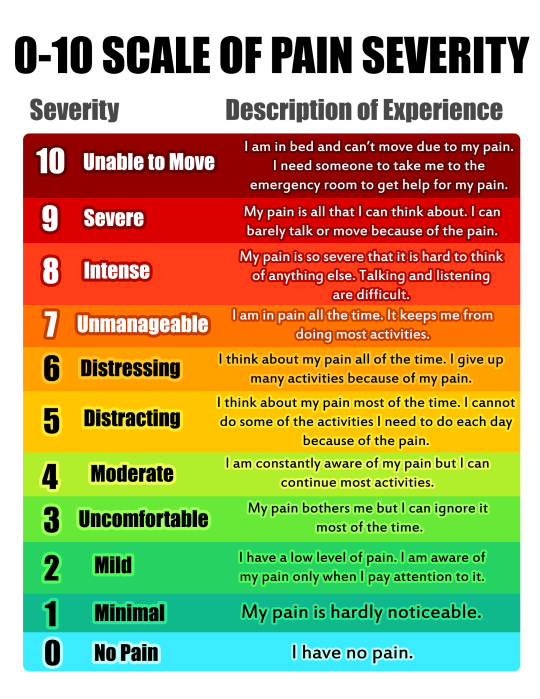
I searched and searched for the post this graphic was from, and the OP deactivated, but I kept the graphic, because my BFF does the same thing, uses her imagination to come up with the worst pain she can imagine and pegs her “10″ there, and so is like, well, I’m conscious, so this must be a 5, and then the doctors don’t take her seriously. (And she then does things like driving herself to the hospital while in the process of giving birth. Probably should have called an ambulance for that one!)
So I found this and sent it to her. Because this is what they want to know: how badly is this pain affecting you? Not on a scale of “nothing” to “how I’d imagine it’d feel if bears were eating my still-living guts while I was on fire”.
I hate reposting stuff, but I’ll never find that post again and OP is deactivated, so, here’s a repost. I can delete this later, i just wanted to get it to you and I can’t embed images in a chat or an ask.
This is possibly why it took several weeks to diagnose my fractured spine.
Pain Scale transcription:
10 – I am in bed and I can’t move due to my pain. I need someone to take me to the emergency room because of my pain.
9 – My pain is all that I can think about. I can barely move or talk because of my pain.
8 – My pain is so severe that it is difficult to think of anything else. Talking and listening are difficult.
7 – I am in pain all the time. It keeps me from doing most activities.
6 – I think about my pain all of the time. I give up many activities because of my pain.
5 – I think about my pain most of the time. I cannot do some of the activities I need to do each day because of the pain.
4 – I am constantly aware of my pain but can continue most activities.
3 – My pain bothers me but I can ignore it most of the time.
2 – I have a low level of pain. I am aware of my pain only when I pay attention to it.
1 – My pain is hardly noticeable.
0 – I have no pain.
It’s also really important to get this kind of scale to people who have chronic pain, because chronic pain drastically lowers your perception of how “bad” any kind of pain actually is, and yet something like this pain scale is extremely user friendly.
For example, if someone asked me how much pain I’m in at any given time, I’d say hardly any, and yet I’m apparently at a chronic 2.5, and it only goes up from there depending on the day.
How to have a conversation about a topic you’re not interested in or don’t know anything about:
Listen to what the other person has to say about the topic.
Ask a question about what they said. Asking them to clarify or explain something you don’t understand is great, but any question will do. All else fails, ask them to explain what they like about some part of the topic.
Listen to their responses and go back to step 2.
Do this until 5-15 minutes has passed, then change the subject to a topic of your interest, unless you are actually interested in learning more on this subject, in which case, go on for as long as you like.
Sometimes, they will say something like “I’m sorry to blather on about [topic].” This is an attempt at a conversational dismount. You can either say “no, it was fascinating, thanks” and then bring up your own topic, or you can say “no, it’s fascinating, please keep going” if you want to keep hearing about their topic. Note the tense difference (past -> moving on, present -> keep going).
I just thought I’d write a script for this, because someone who can’t / won’t do this came up in a Captain Awkward column, and listening about topics you have no interest in is a really useful skill to have and not often explicitly taught, particularly to boys and men.
DAILY FIND: Sometimes the Internet is a crappy place full of crap. But today I’m reminded that it’s an amazing trove of free and good information from reliable sources: The University of Illinois Extension has created a searchable index of every stain known to manand stain removal solutions for each. The tool will even tell you what your window of stain-treatment time is to achieve optimal results.
This is nerd GOLD, people. Use it in good health. -ts
UFYH, have you seen this?
So I keep saying that I don’t have a degree from stain college, but apparently the University of Illinois Extension is, in fact, stain college, so you should check this database out.
Writing? I was thinking more along the lines of the fact that I keep trying to feed my boobs and I’d really like to get some of those stains out of my clothes.
THIS IS AN IMPORTANT ONE! Don’t ignore this in your writing!
As a person who writes mainly emotionally strong scenes in regards to trauma and flashbacks and such, I can’t stress this enough. All the best writing I’ve read that really make you feel follows these guidelines. I’m not perfect with writing emotions, but I have improved a great deal by following these kinds of tips.
So I found this app called Scan Halal where you scan the bar code of your food and it tells you if its halal or not. It’s a free app too. Pass this on so others can see and worry a little less about their food/snack choices
Yessss, it is very handy especially in non-muslim countries
If you reblog this for no other reason, do it because it’ll piss off Pauline Hanson. And pissing off Pauline Hanson is reason enough to do anything.
Pissing off Pauline Hanson is my favourite pass time
If you reblog this for no other reason, reblog it to make a Muslim feel safer, more accepted, and/or more informed about food.
Other people and their needs are not your game pieces to use to offend others or make yourself feel better.
The dos and don’ts of designing for accessibility are general guidelines, best design practices for making services accessible in government. Currently, there are six different posters in the series that cater to users from these areas: low vision, D/deaf and hard of hearing, dyslexia, motor disabilities, users on the autistic spectrum and users of screen readers.
[…] Another aim of the posters is that they’re meant to be general guidance as opposed to being overly prescriptive. Using bright contrast was advised for some (such as those with low vision) although some users on the autistic spectrum would prefer differently. Where advice seems contradictory, it’s always worth testing your designs with users to find the right balance, making compromises that best suit the users’ needs.
i’ve put together fun fic prompt generator with thousands of possible combinations! each prompt combines different settings, genres, tropes, and a prompt idea to get you started in a direction. you can use one or more of the ideas or the entire combination if it works out, or just refresh until you’re inspired.
two versions! the safe for work version includes all pg-13 prompts, and the nsfw version includes a kink category as well as many more sexytime prompts.



 Steel Phoenix Studios