I am 100% convinced that “exit, pursued by a bear” is a reference to some popular 1590s meme that we’ll never be able to understand because that one play is the only surviving example of it.
Seriously, we’ll never figure it out. I’ll wager trying to understand “exit, pursued by a bear” with the text of The Winter’s Tale as our primary source is like trying to understand loss.jpg when all you have access to is a single overcompressed JPEG of a third-generation memetic mutation that mashes it up with YMCA and “gun” – there’s this whole twitching Frankensteinian mass of cultural context we just don’t have any way of getting at.
no, but this is why people do the boring archival work! because we think we do know why “exit, pursued by a bear” exists, now, and we figured it out by looking at ships manifests of the era –
it’s also why there was a revival of the unattributed and at the time probably rather out of fashion mucedorus at the globe in 1610 (the same year as the winter’s tale), and why ben jonson wrote a chariot pulled by bears into his court masque oberon, performed on new year’s day of 1611.
we think the answer is polar bears.
no, seriously! in late 1609 the explorer jonas poole captured two polar bear cubs in greenland and brought them home to england, where they were purchased by the beargarden, the go-to place in elizabethan london for bear-baiting and other ‘animal sports.’ it was at the time run by edward alleyn (yes, the actor) and his father-in-law philip henslowe (him of the admiral’s men and that diary we are all so very grateful for), and would have been very close, if not next to, the globe theatre.
of course, polar bear cubs are too little and adorable for baiting, even to the bloodthirsty tudor audience, aren’t they? so, what to do with the little bundles of fur until they’re too big to be harmless? well, if there’s anything we know about the playwrights and theatre professionals of the time, it’s that they knew how to make money and draw in audiences. and the spectacle of a too-small-to-be-dangerous-yet-but-still-real-live-and-totally-WHITE-bear? what good entertainment businessman is going to turn down that opportunity?
and, voila, we have a death-by-bear for the unfortunate antigonus, thereby freeing up paulina to be coupled off with camillo in the final scene, just as the comedic conventions of the time would expect.
you’re telling me it was an ACTUAL BEAR
every time I think to myself “history can’t possibly get any more bananas” I realize or am made to realize that I am badly mistaken
– where Puck isn’t just trolling everyone, but is legitimately the most powerful and dangerous person in the story?
They do everything for their ‘master’. They’re the one to ‘put a girdle ‘round the earth in forty minutes’. They’re the one who switches Bottom’s head out for a donkey’s. They’re the one who waylays the lovers and gets them all together so the love square can be resolved. They’re the only one doing magic, getting things done. And yes, it’s all under Oberon’s direction but,
imagine if, when Oberon snaps “Helena of Athens, look now, find!”
Puck turns and stares at him, maybe gets right in his face with that unblinking look, and says quite quietly “I go, I go, look how I go; swift as an arrow from the tartar’s bow.”
And, having reminded Oberon exactly who has the power here, they step back, dismiss him and walk calmly off, leaving Oberon very shaken.
As a transgender man who is going to be having a baby, I am so glad that by technicality my child will be able to fulfil the prophecy and defeat Macbeth.
To be on the safe side, get a C-section? Macbeth really needs defeating.
Ironically I do have to have a C-section due to a hip problem I have. So it’s double accurate.
I like how this post implies that Macbeth is still out there, most likely terrorizing people, and no one has been able to stop him
Women have more power and agency in Shakespeare’s comedies than in his tragedies, and usually there are more of them with more speaking time, so I’m pretty sure what Shakespeare’s saying is “men ruin everything” because everyone fucking dies when men are in charge but when women are in charge you get married and live happily ever after
I think you’re reading too far into things, kiddo. Take a break from your women’s studies major and get some fresh air.
Right. Well, I’m a historian, so allow me to elaborate.
One of the most important aspects of the Puritan/Protestant revolution (in the 1590’s in particular) was the foregrounding of marriage as the most appropriate way of life. It often comes as a surprise when people learn this, but Puritans took an absolutely positive view of sexuality within the context of marriage. Clergy were encouraged to lead by example and marry and have children, as opposed to Catholic clergy who prized virginity above all else.Through his comedies, Shakespeare was promoting this new way of life which had never been promoted before. The dogma, thanks to the church, had always been “durr hburr women are evil sex is bad celibacy is your ticket to salvation.” All that changed in Shakespeare’s time, and thanks to him we get a view of the world where marriage, women, and sexuality are in fact the key to salvation.
The difference between the structure of a comedy and a tragedy is that the former is cyclical, and the latter a downward curve. Comedies weren’t stupid fun about the lighter side of life. The definition of a comedy was not a funny play. They were plays that began in turmoil and ended in reconciliation and renewal. They showed the audience the path to salvation, with the comic ending of a happy marriage leaving the promise of societal regeneration intact. Meanwhile, in the tragedies, there is no such promise of regeneration or salvation. The characters destroy themselves. The world in which they live is not sustainable. It leads to a dead end, with no promise of new life.
And so, in comedies, the women are the movers and shakers. They get things done. They move the machinery of the plot along. In tragedies, though women have an important part to play, they are often morally bankrupt as compared to the women of comedies, or if they are morally sound, they are disenfranchised and ignored, and refused the chance to contribute to the society in which they live. Let’s look at some examples.
In Romeo and Juliet, the play ends in tragedy because no-one listens to Juliet. Her father and Paris both insist they know what’s right for her, and they refuse to listen to her pleas for clemency. Juliet begs them – screams, cries, manipulates, tells them outright I cannot marry, just wait a week before you make me marry Paris, just a week, please and they ignore her, and force her into increasingly desperate straits, until at last the two young lovers kill themselves. The message? This violent, hate-filled patriarchal world is unsustainable. The promise of regeneration is cut down with the deaths of these children. Compare to Othello. This is the most horrifying and intimate tragedy of all, with the climax taking place in a bedroom as a husband smothers his young wife. The tragedy here could easily have been averted if Othello had listened to Desdemona and Emilia instead of Iago. The message? This society, built on racism and misogyny and martial, masculine honour, is unsustainable, and cannot regenerate itself. The very horror of it lies in the murder of two wives.
How about Hamlet? Ophelia is a disempowered character, but if Hamlet had listened to her, and not mistreated her, and if her father hadn’t controlled every aspect of her life, then perhaps she wouldn’t have committed suicide. The final scene of carnage is prompted by Laertes and Hamlet furiously grappling over her corpse. When Ophelia dies, any chance of reconciliation dies with her. The world collapses in on itself. This society is unsustainable. King Lear – we all know that this is prompted by Cordelia’s silence, her unwillingness to bend the knee and flatter in the face of tyranny. It is Lear’s disproportionate response to this that sets off the tragedy, and we get a play that is about entropy, aging and the destruction of the social order.
There are exceptions to the rule. I’m sure a lot of you are crying out “but Lady Macbeth!” and it’s a good point. However, in terms of raw power, neither Lady Macbeth nor the witches are as powerful as they appear. The only power they possess is the ability to influence Macbeth; but ultimately it is Macbeth’s own ambition that prompts him to murder Duncan, and it is he who escalates the situation while Lady Macbeth suffers a breakdown. In this case you have women who are allowed to influence the play, but do so for the worse; they fail to be the good moral compasses needed. Goneril, Regan and Gertrude are similarly comparable; they possess a measure of power, but do not use it for good, and again society cannot renew itself.
Now we come to the comedies, where women do have the most control over the plot. The most powerful example is Rosalind in As You Like It. She pulls the strings in every avenue of the plot, and it is thanks to her control that reconciliation is achieved at the end, and all end up happily married. Much Ado About Nothing pivots around a woman’s anger over the abuse of her innocent cousin. If the men were left in charge in this play, no-one would be married at the end, and it would certainly end in tragedy. But Beatrice stands up and rails against men for their cruel conduct towards women and says that famous, spine-tingling line – oh God, that I were a man! I would eat his heart in the marketplace. And Benedick, her suitor, listens to her. He realises that his misogynistic view of the world is wrong and he takes steps to change it. He challenges his male friends for their conduct, parts company with the prince, and by doing this he wins his lady’s hand. The entire happy ending is dependent on the men realising that they must trust, love and respect women. Now it is a society that it worthy of being perpetuated. Regeneration and salvation lies in equality between the sexes and the love husbands and wives cherish for each other. The Merry Wives of Windsor – here we have men learning to trust and respect their wives, Flastaff learning his lesson for trying to seduce married women, and a daughter tricking everyone so she can marry the man she truly loves. A Midsummer Night’s Dream? The turmoil begins because three men are trying to force Hermia to marry someone she does not love, and Helena has been cruelly mistreated. At the end, happiness and harmony comes when the women are allowed to marry the men of their choosing, and it is these marriages that are blessed by the fairies.
What of the romances? In The Tempest, Prospero holds the power, but it is Miranda who is the key to salvation and a happy ending. Without his daughter, it is likely Prospero would have turned into a murderous revenger. The Winter’s Tale sees Leontes destroy himself through his own jealousy. The king becomes a vicious tyrant because he is cruel to his own wife and children, and this breach of faith in suspecting his wife of adultery almost brings ruin to his entire kingdom. Only by obeying the sensible Emilia does Leontes have a chance of achieving redemption, and the pure trust and love that exists between Perdita and Florizel redeems the mistakes of the old generation and leads to a happy ending. Cymbeline? Imogen is wronged, and it is through her love and forgiveness that redemption is achieved at the end. In all of these plays, without the influence of the women there is no happy ending.
The message is clear. Without a woman’s consent and co-operation in living together and bringing up a family, there is turmoil. Equality between the sexes and trust between husbands and wives alone will bring happiness and harmony, not only to the family unit, but to society as a whole. The Taming of the Shrew rears its ugly head as a counter-example, for here a happy ending is dependent on a woman’s absolute subservience and obedience even in the face of abuse. But this is one of Shakespeare’s early plays (and a rip-off of an older comedy called The Taming of a Shrew) and it is interesting to look at how the reception of this play changed as values evolved in this society.
As early as 1611 The Shrew was adapted by the writer John Fletcher in a play called The Woman’s Prize, or The Tamer Tamed. It is both a sequel and an imitation, and it chronicles Petruchio’s search for a second wife after his disastrous marriage with Katherine (whose taming had been temporary) ended with her death. In Fletcher’s version, the men are outfoxed by the women and Petruchio is ‘tamed’ by his new wife. It ends with a rather uplifting epilogue that claims the play aimed:
To teach both sexes due equality
And as they stand bound, to love mutually.
The Taming of the Shrew and The Tamer Tamed were staged back to back in 1633, and it was recorded that although Shakespeare’s Shrew was “liked”, Fletcher’s Tamer Tamed was “very well liked.” You heard it here folks; as early as 1633 audiences found Shakespeare’s message of total female submission uncomfortable, and they preferred John Fletcher’s interpretation and his message of equality between the sexes.
So yes. The message we can take away from Shakespeare is that a world in which women are powerless and cannot or do not contribute positively to society and family is unsustainable. Men, given the power and left to their own devices, will destroy themselves. But if men and women can work together and live in harmony, then the whole community has a chance at salvation, renewal and happiness.
Taking another short break from Twelfth Night. OK, so I’m over a year late to get on the Hamilton bandwagon. I’ve been geeking out about it from afar but only recently made the time to actually sit down and listen properly to the whole thing.
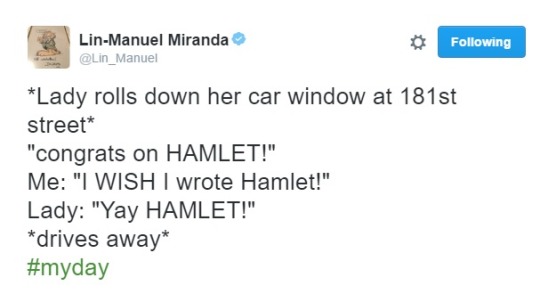
It’s hardly revolutionary (SEE WHAT I DID THERE?) to make a connection between Hamilton and Hamlet. Hamilton’s creator, Lin-Manuel Miranda, got the ball rolling with this recorded encounter:
Well, I’ve never met a musical number that I haven’t wanted to at least try to parody, so I thought I’d take a song from Hamilton and rework it a bit… into Hamleton. It was not easy, as Miranda’s lyrics are very dense and intricate, and I’m not entirely sure I’ve succeeded, but here it is anyways. Many thanks to Dan Beaulieu of the Seven Stages Shakespeare Company and No Holds Bard Podcast for acting as Lyrical Dramaturge on this effort.
of course, the irony about this cartoon – which I assume is meant to demonstrate shallow selfie culture desecrating the great classics – is that among other things a) hamlet is a disaffected young man suffering from depression and, frankly, deeply self-absorbed and b) the entire play is obsessed with the idea of performance and performativity and so absolutely hamlet taking selfies would be in the spirit of the original because a selfie is a new way of constructing the self through images
so what I’m saying is: fuck off culture snobs I’m coming for you
Yeah, my first thought was definitely “huh. That would make for a pretty good adaptation.”
absolutely. I can’t think of anything more in character for Hamlet than filling his snapchat with selfies taken in super-moody lighting with weird angsty captions about the peace of the grave, and no one can decide whether he’s losing his grip or if he’s a master of subtweeting
An adaptation of Hamlet told entirely through Hamlet’s SnapChats.
Someone: POLITICS and ART should always be SEPARATE! There is NO REASON why ART should be POLITICAL!
William Shakespeare: *laughs. writes 3 more tiny hand jokes into his latest play, King Tiny Hands.*


 Steel Phoenix Studios