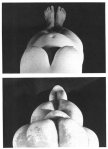
evidence that ancient paleolithic venus statues were made by women who were examining their own bodies and sculpting them from their own point of view, not, as previously assumed, exaggerated features from an outside perspective
Wait, wait…. Is that seriously it? How their clothes go?
that genuinely is it
yeah hey whats up bout to put some fucking giant sheets on my body
lets bring back sheetwares
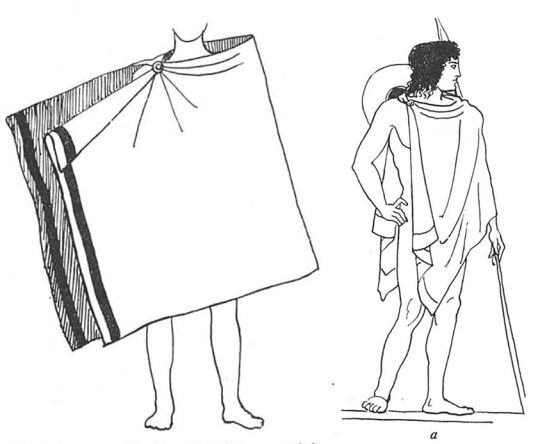
also chlamys:
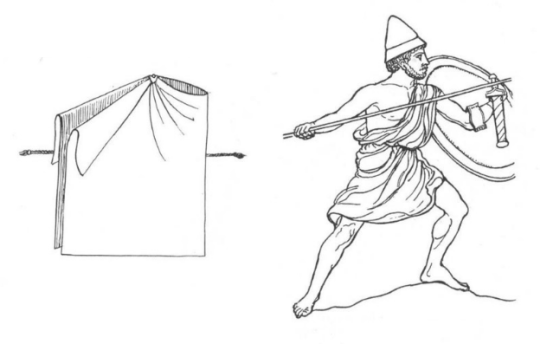
and exomis:
trust the ancients to make a fashion statement out of straight cloth and nothing but pins
Wrap Yourself In Blankets, Call It a Day
Ok, yes, but guys, look
Prior to the Industrial Revolution, fabric was EXTREMELY time consuming to make, and as such, was extremely valuable. You have to grow your fiber, either in the ground or on an animal. You have to process the fiber. You have to spin the fiber. And spin, and spin, and spin. Spinning technology prior to the late Middle Ages consisted of a drop spindle. It takes forever and a day to spin enough thread to make fabric using a drop spindle – 10-30 times longer than to weave it, depending on how thick your yarn is and what weaving technology you are using. Then, once you are done with that endless task, you need to weave it. The examples in this post are all from Greece, where they used the warp-weighted loom, which is actually a rather efficient piece of weaving technology, but it’s still not as fast as the treadle loom (another late Middle Ages invention) and in no way comparable to a modern industrial loom (essentially the same machine as a treadle loom, but automated (except warping, which is still hell on earth even in 2018)). You know the saying “women’s work is never done”? That saying refers to the fact that unlike, say, field work, or mining, or smithing, spinning and weaving were started before dawn and carried on until after dusk, every day of the year, and there was always, always need for more.
After all of this, every piece of fabric that is made represents literally hundreds of hours of work. It is so valuable it was a standard form of currency before the invention of money. Egyptians piled linen high in their tombs as a show of wealth – and that linen was stolen by the grave robbers along with the gold and other precious artifacts. Textiles were one of the most valuable things you could steal when you pillaged a city. A primary reason for the warfare and raiding that was a consistent part of pre-modern Mediterranean/Near Eastern history was to acquire female slaves to produce textiles. Yes, cooking, cleaning, and sex were also reasons to acquire female slaves, but the economic reason was for textile manufacturing.
So if fabric is that valuable, you’re not going to waste it. You’re not going to make something tightly tailored, because as anyone who sews can tell you, cutting fabric to fit produces a lot of waste. In addition, the cloth of the ancient world was often much more loosely woven than cloth today, which is partly to do with weaving technology but most to do with the fact that the denser the cloth, the more threads there are in it, which means the more threads you have to spin for it, which means the time you have to spend making it has just gone up dramatically. Loosely woven cloth ravels like hell when you cut it, again as anyone who sews can tell you, and that makes it much more difficult to sew something nicely tailored. Needles and scissors are also items we take for granted, but are, in their modern form, relatively modern inventions and have, historically, been tricky items to make.
Thus, most of the clothing of the ancient Mediterranean/Near East was based on the rectangles of fabric that come directly off the loom. Much of China’s historical dress is similar, at least in the time frames we’re talking about. Throughout European/North African/Middle Eastern history, and in China until silk changed the game (at least for the rich), tailoring skill and technology has lagged behind cloth production skill and technology.
The famous painting from the early Renaissance where the woman is wearing a dress constructed using a truly obscene amount of fabric? That painting is often held up as an example of the sharp increase in the availability of material goods that is the hallmark of the European Renaissance (especially because it is of a merchant family and not nobles), and it is that. But it is also an example of a mode of dress that was difficult-to-impossible to achieve before the invention of the flyer wheel (for spinning) and treadle loom (for weaving), which made cloth take considerably less time to make and therefore considerably cheaper, and which also made cloth considerably more amenable to tailoring.
So yeah. You too would make fashion out of sheets if it took you most of a month of full-time work to produce one sheet.
I also want to point out that much of the historical dress of Sub-Saharan Africa and the Americas (in the places where cloth was used) is similar, it’s just based on narrow rectangles sewn together rather than large rectangles, because these are places where the backstrap loom and/or tubular loom remained the mainstay of weaving technology. Backstrap looms produce narrow lengths of cloth (15-18 inches is usually the limit), so with that weaving technology + some sewing, you get things like Central and South American ponchos and much of the traditional dress of Central and Western Africa.
So, I recently saw a post on my dash with someone lamenting the fact that in the medieval era, they would have been considered ugly as there was no makeup, and someone else offering a well-meant attempt to reassure them: that since they’d have no pox scars, rotten teeth, filthy hair, etc, all medieval men would think they were amazingly hot. While I appreciate the sentiment, there’s…. more than a little mythology on both sides of this idea, and frankly, our medieval foremothers would be surprised and insulted to hear that they were apparently the stereotyped bunch of unwashed, snaggle-toothed crones who put no care or effort into their appearance, and had no tools with which to do so.
(Or: Yep. Hilary Has More Things To Say. You probably know where this is going.)
I answered an ask a couple weeks ago that was mostly about medieval gynecological care and the accuracy of the “mother dying in childbirth” stereotype, but which also touched on some of the somehow still-widely-believed myths about medieval personal care and cleanliness. Let’s start with bathing. Medieval people bathed, full stop. Not as frequently as we do, and not in the same ways, but the “people never washed in Ye Olde Dark Ages” chestnut needs to be decidedly consigned to the historical dustbin where it belongs. “A Short History of Bathing Before 1601″ is a good place to start, as it follows the development of bathing culture from ancient Rome (where bathhouses were known for their use as gathering places and influential centers of political debate) through to the modern era. Yes, common people as well as the nobility washed fairly frequently. Bathing was a favored social and leisure activity and a central part of hospitality for guests. Hey, look at all these images in medieval manuscripts of people bathing. Or De balneis Puteolanis, which is basically a thirteenth-century travel guide to the best baths in Italy. Or these medieval Spanish civic codes about when men, women, and Jews were allowed to use the public bath house. There was also, as referenced in the above ask, the practice of washing faces, hands, etc daily, and sometimes more than once. Feasts involved elaborate protocol about who was allowed to perform certain tasks, including bringing in the bowls of scented water to wash between courses. They associated filth with disease (logically). Anyway. Let’s move on.
Combs are some of the oldest (and most common) objects found in medieval graves – i.e. they were a standard part of the “grave goods” for the deceased, and were highly valued possessions. Look, it’s a young woman combing her hair (that article also discusses the history of medieval makeup for men, which was totally a thing and likewise also suspected of being “unmanly.”) The Luttrell Psalter, now in the British Library, includes among its many illuminations one of a young woman having her hair elaborately combed and styled by an attendant. There were extensive discourses on what constituted an ideally attractive medieval woman, and the study of aesthetics and the nature of beauty is one of the oldest and most central philosophical enquiries in the world (as were beauty standards in antiquity). Having a pale complexion was a sign of wealth (you didn’t have to work outdoors in the sun) and women used all kinds of pastes and powders to achieve that effect. Remember the Trotula, the medieval gynecological textbook we talked about in the childbirth ask? Well, it is actually three texts, and the entire third text, De ornatu mulierum (On Women’s Cosmetics) is dedicated to makeup and cosmetics. What weird and gross sort of things do they advocate, cry editors of “7 Horrifying Medieval Beauty Tips You Won’t Believe!”-style articles? Well…
First come general depilatories for overall care of the skin. Then there are recipes for care of the hair: for making it long and dark, thick and lovely, or soft and fine. For care of the face, there are recipes for removing unwanted hair, whitening the skin, removing blemishes or abscesses, and exfoliating the skin, plus general facial creams. For the lips, there is a special unguent of honey to soften them, plus colorants to dye the lips and gums. For the care of teeth and prevention of bad breath, there are five different recipes. The final chapter is on hygiene of the genitalia. […] A prescription said to be used by Muslim women then follows.[…] The author gives detailed instructions on how to apply the water just prior to intercourse, together with a powder that the woman is supposed to rub on her chest, breasts, and genitalia. She is also to wash her partner’s genitals with a cloth sprinkled with the same sweet-smelling powder.
Wait so… hair care, skin and facial creams, toothpaste, lipstick, and sexual hygiene?? With the latter based on that used by Muslim women??? Zounds! How strange and unthinkable!
L’ornement des Dames, an Anglo-Norman text of the thirteenth century, offers more tips and tricks, and explicitly references the authority of both the Trotula and Muslim women: “I shall not forget either what I learnt at Messina from a Saracen woman. She was a doctor for the people of her faith […] according to what I heard from Trotula of Salerno, a woman who does not trust her is a fool.” So yes. The beauty regimes of Muslim women were transmitted to and shared by Christian women, especially in diverse places like medieval Sicily, and this was valuable and trusted advice. Gee. It’s almost like women have always a) cared about their appearance, and b) united to flip one giant middle finger at the patriarchy. (You can also read more about skincare and cosmetics.) Speaking of female health authorities, you have definitely (or you should have) heard of Hildegard von Bingen, a twelfth-century abbess and towering genius who was the trusted advisor of kings and popes and wrote treatises on everything from music to medicine to natural science (she is regarded as the founder of the discipline in Germany). This included the vast Physica, a handbook on health and medicine, and Causae et curae, another medical textbook.
Did the church grumble and gripe about women putting on excessive adornments and being too fixated by makeup and the dangers of vanity and etc etc? You bet they did. Did women ignore the hell out of this and wear makeup and fancy clothes anyway? You bet they damn well did. Also, medieval society was fuckin’ obsessed with fashion (especially in the fourteenth century.) The sumptuary laws, which appeared for the first time in the late thirteenth and early fourteenth centuries, regulated which classes of society were allowed to wear what (so that fancy furs and silks and jewels were reserved for the nobility, and less expensive cloth and trimming were the province of the lower classes – the idea was that you could know someone’s station in life just by looking at them). These were insanely detailed, and went down to regulating the height of someone’s high heels. So yes, theoretically, the stiletto police could stop you in fourteenth-century England, whip out a measuring tape, and see if you were literally too big for your britches.
(”But, but,” you stammer. “Surely they had rotten teeth?” Well, this is probably a bad time to note that in addition to the five toothpaste remedies mentioned in the Trotula, there are even more. Jewish and Muslim natural philosophers and herbalists had all kinds of recommendations – see Practical Materia Medica of the Medieval Eastern Mediterranean. Also, since there was no processed sugar in their diet, their dentistry was far better than, say, the Elizabethans, and white and regular teeth were highly prized. There would be wear and tear from grist, but since fine-milled white bread was a status symbol, the wealthy could afford to have bread that did not contain it, and thus good teeth.)
Of course, everyone wasn’t just getting dressed up with, so to speak, nowhere to go. What about sex? It never happened unless it was marital rape, right? (/side-eyes a certain unnamed quasi-medieval television show). Oh no. Medieval people loved the shit out of sex. Pastourelles were an immensely popular poetic genre which almost always included the protagonist having a romp with a pretty shepherdess, and anyone who’s read any Chaucer knows how bawdy it can get. Even Chaucer, however, is put to shame by the fabliaux, which are a vast collection of Old French poems that have titles so ribald that I could not say them aloud to an undergraduate class. (”The Ring That Controlled Erections” and “The Peekaboo Priest” are about the tamest that I can think of, but I gotta say I’m fond of “Long Butthole Berengier” and the one called simply “The Fucker,” because literally people are people everywhere and always. And yes, you perverted person, you can read the lot of them here.) This was incredibly explicit and bawdy popular literature that was pretty much exactly medieval porn (and like usual porn, did not exactly serve as any kind of precursor of feminist media or positive female representation, but Misogyny, Take a Shot.)
So yes. Once more (surprise!) the history of cosmetics goes back at least six thousand years, and is one of the oldest aspects of documented social history in the world. It existed broadly and accessibly in the medieval world, where women had other women writing books on it for them, and was just as much as a concern as it is now. People have always liked to look good, smell good, accessorize, dress fashionably, try weird beauty trends, and so forth. So if by some accident you do stumble into a time machine and end up in medieval Europe, you’ll have plenty of choices. Our medieval foremothers, and the men who loved them and thought they were beautiful, thank you for your time.
This is amazing. So many facts and links! Hope this post blows up big style 🙂
I really enjoyed this post, thank you!
A post about medieval history that’s actually researched and has links to primary sources? I am very here for this.
I honestly always find the term ‘spinster’ as referring to an elderly, never-married woman as funny because you know what?
Wool was a huge industry in Europe in the middle ages. It was hugely in demand, particularly broadcloth, and was a valuable trade good. A great deal of wool was owned by monasteries and landed gentry who owned the land.
And, well, the only way to spin wool into yarn to make broadcloth was by hand.
This was viewed as a feminine occupation, and below the dignity of the monks and male gentry that largely ran the trade.
So what did they do?
They hired women to spin it. And, turns out, this was a stable job that paid very well. Well enough that it was one of the few viable economic options considered ‘respectable’ outside of marriage for a woman. A spinster could earn quite a tidy salary for her art, and maintain full control over her own money, no husband required.
So, naturally, women who had little interest in marriage or men? Grabbed this opportunity with both hands and ran with it. Of course, most people didn’t get this, because All Women Want Is Husbands, Right?
So when people say ‘spinster’ as in ‘spinster aunt’, they are TRYING to conjure up an image of a little old lady who is lonely and bitter.
But what I HEAR are the smiles and laughter of a million women as they earned their own money in their own homes and controlled their own fortunes and lived life on their own terms, and damn what society expected of them.
So the other night during D&D, I had the sudden thoughts that:
1) Binary files are 1s and 0s
2) Knitting has knit stitches and purl stitches
You could represent binary data in knitting, as a pattern of knits and purls…
You can knit Doom.
However, after crunching some more numbers:
The compressed Doom installer binary is 2.93 MB. Assuming you are using sock weight yarn, with 7 stitches per inch, results in knitted doom being…
3322 square feet
Factoring it out…302 people, each knitting a relatively reasonable 11 square feet, could knit Doom.
Hi fun fact!!
The idea of a “binary code” was originally developed in the textile industry in pretty much this exact form. Remember punch cards? Probably not! They were a precursor to the floppy disc, and were used to store information in the same sort of binary code that we still use:
Here’s Mary Jackson (c.late 1950s) at a computer. If you look closely in the yellow box, you’ll see a stack of blank punch cards that she will use to store her calculations.
This is what a card might look like once punched. Note that the written numbers on the card are for human reference, and not understood by the computer.
But what does it have to do with textiles? Almost exactly what OP suggested. Now even though machine knitting is old as balls, I feel that there are few people outside of the industry or craft communities who have ever seen a knitting machine.
Here’s a flatbed knitting machine (as opposed to a round or tube machine), which honestly looks pretty damn similar to the ones that were first invented in the sixteenth century, and here’s a nice little diagram explaining how it works:
But what if you don’t just want a plain stocking stitch sweater? What if you want a multi-color design, or lace, or the like? You can quite easily add in another color and integrate it into your design, but for, say, a consistent intarsia (two-color repeating pattern), human error is too likely. Plus, it takes too long for a knitter in an industrial setting. This is where the binary comes in!
Here’s an intarsia swatch I made in my knitwear class last year. As you can see, the front of the swatch is the inverse of the back. When knitting this, I put a punch card in the reader,
and as you can see, the holes (or 0′s) told the machine not to knit the ground color (1′s) and the machine was set up in such a way that the second color would come through when the first color was told not to knit.
tl;dr the textiles industry is more important than people give it credit for, and I would suggest using a machine if you were going to try to knit almost 3 megabytes of information.
It goes beyond this. Every computer out there has memory. The kind of memory you might call RAM. The earliest kind of memory was magnetic core memory. It looked like this:
Wires going through magnets. This is how all of the important early digital computers stored information temporarily. Each magnetic core could store a single bit – a 0 or a 1. Here’s a picture of a variation of this, called rope core memory, from one NASA’s Apollo guidance computers:
You may think this looks incredibly handmade, and that’s because it is. But these are also extreme close-ups. Here’s the scale of the individual cores:
The only people who had the skills necessary to thread all of these cores precisely enough were textile and garment workers. Little old ladies would literally thread the wires by hand.
And thanks to them, we were able to land on the moon. This is also why memory in early computers was so expensive. It had to be hand-crafted, and took a lot of time.
Don’t underestimate the impact craft has had on our culture
I literally can’t get myself to sit through movies that don’t have women. I’m like where the fuck are the women? Why are there so many men? This is boring as fuck goodbye
Even if it’s historically accurate?
as everyone knows, women were invented in 1990
All the notes of “women weren’t on old time battlefields” are wrong. There were more prostitutes and merchant women than there were soldiers in most every encampment. They followed the armies, marching alongside them, and notably ran the camps.
Many more women dressed as men to fight.
Long before female nurses were officially considered to be a part of the military, they were already on the battlefield. They merely didn’t get written into official reports because they were “invisible women”, “not supposed to be there”. Usually they would be local women running a makeshift care center out of their homes.
Movies involving ancient societies? Guess how many had female fighters?
Spies? Mostly female. Yeah, only the men were caught, usually (because nobody suspected the servant woman), but historians believe most cases had more women spies than men. Most cases meaning across time and continents.
Giving me a movie on samurai? Women were trained as well to avoid being captured and raped, and often fought just as hard as men. One woman notably survived multiple battles, and became a hero alongside her sisters after taking out 7 men before dying in her last fight (usually in sword fighting you’d be lucky to take out 2 enemy soldiers. 7 is fucking insane, but because she was a woman it was shoved under the records how the lord managed to survive).
Women have ALWAYS been on battlefields. Women have an intense history in driving victories and losses alike. They were supply runners, fighters, spies, assassins, prostitutes (look up how prostitutes essentially ran the western world, or even the social status of harem members. They literally fucking ruled), even underground activists.
The only time there weren’t many women were with cowboys. Actual western cowboys tended to be both POC and gay. In fact, any time women didn’t have a near equal or greater presence, there was a LOT of gay men.
History: either 80% female or 100% gay. And it’s 95% POC.
Open a bank account or get a credit card without signed permission from her father or hr husband.
Serve on a jury – because it might inconvenience the family not to have the woman at home being her husband’s helpmate.
Obtain any form of birth control without her husband’s permission. You had to be married, and your hub and had to agree to postpone having children.
Get an Ivy League education.
Ivy League schools were men’s colleges ntil the 70′s and 80′s. When
they opened their doors to women it was agree that women went there for
their MRS. Degee.
Experience equality in the workplace: Kennedy’s
Commission on the Status of Women produced a report in 1963 that
revealed, among other things, that women earned 59 cents for every
dollar that men earned and were kept out of the more lucrative
professional positions.
Keep her job if she was pregnant.Until the Pregnancy Discrimination Act in 1978, women were regularly fired from their workplace for being pregnant.
Refuse to have sex with her husband.The mid 70s saw most states recognize marital rape and in 1993 it became criminalized
in all 50 states. Nevertheless, marital rape is still often treated
differently to other forms of rape in some states even today.
Get a divorce with some degree of ease.Before the No Fault Divorce
law in 1969, spouses had to show the faults of the other party, such as
adultery, and could easily be overturned by recrimination.
Have a legal abortion in most states.The Roe v. Wade case in 1973 protected a woman’s right to abortion until viability.
Take legal action against workplace sexual harassment.
Play college sports
Title IX of the Education
Amendments of protects people from discrimination based
on sex in education programs or activities that receive Federal
financial assistance
It was nt until this statute that colleges had teams for women’s sports
Apply for men’s Jobs
The EEOC rules that
sex-segregated help wanted ads in newspapers are illegal. This ruling
is upheld in 1973 by the Supreme Court, opening the way for women to
apply for higher-paying jobs hitherto open only to men.
This is why we needed feminism – this is why we know that feminism works
I just want to reiterate this stuff, because I legit get the feeling there are a lot of younger women for whom it hasn’t really sunk in what it is today’s GOP is actively trying to return to.
Did you go to a good college? Shame on you, you took a college placement that could have gone to a man who deserves and needs it to support or prepare for his wife & children. But if you really must attend college, well, some men like that, you can still get married if you focus on finding the right man.
Got a job? Why? A man could be doing that job. You should be at home caring for a family. You shouldn’t be taking that job away from a man who needs it (see college, above). You definitely don’t have a career – you’ll be pregnant and raising children soon, so no need to worry about promoting you.
This shit was within living memory.
I’M A MILLENIAL and my mother was in the second class that allowed women at an Ivy League school.
Men who are alive today either personally remember shit like this or have parents/family who have raised them into thinking this was the way America functioned back in the blissful Good Old Days. There are literally dudes in the GOP old enough to remember when it was like this and yearn for those days to return.
When people talk about resisting conservativism and the GOP, we’re not just talking about whether the wage gap is a myth or not. We’re talking about whether women even have the fundamental right to exist as individuals, to run their own households and compete for jobs and be considered on an equal footing with men in any arena at all in the first place.
I was a child in the 1960s, a teenager in the 1970s, a young adult in the 1980s. This is what it was like:
When I was growing up, it was considered unfortunate if a girl was good at sports. Girls were not allowed in Little League. Girls’ teams didn’t exist in high school, except at all-girls’ high schools. Boys played sports, and girls were the cheerleaders.
People used to ask me as a child what I wanted to be when I grew up. I said I wanted to be a brain surgeon or the first woman justice on the Supreme Court. Everyone told me it was impossible–those just weren’t realistic goals for a girl–the latter, especially, because you couldn’t trust women to judge fairly and rationally, after all.
In the 1960s and 1970s, all women were identified by their marital status, even in arrest reports and obituaries. In elementary school, my science teacher referred to Pierre Curie as DOCTOR Curie and Marie Curie as MRS. Curie…because, as he put it, “she was just his wife.” (Both had doctorates and both were Nobel prize winners, so you would think that both would be accorded respect.)
Companies could and did require women to wear dresses and skirts. Failure to do could and did get women fired. And it was legal. It was also legal to fire women for getting married or getting pregnant. The rationale was that a woman who was married or who had a child had no business working; that was what her husband was for. Aetna Insurance, the biggest insurance company in America, fired women for all of the above.
A man could rape his wife. Legally. I can remember being twelve years old and reading about legal experts actually debating whether or not a man could actually be said to coerce his wife into having sex. This was a serious debate in 1974.
The debate about marital rape came up in my law school, too, in 1984. Could a woman be raped by her husband? The guys all said no–a woman got married, so she was consenting to sex at all times. So I turned it around. I asked them if, since a man had gotten married, that meant that his wife could shove a dildo or a stick or something up his ass any time she wanted to for HER sexual pleasure.
(Hey, I thought it was reasonable. If one gender was legally entitled to force sex on the other, then obviously the reverse should also be true.)
The male law students didn’t like the idea. Interestingly, they commented that being treated like that would make them feel like a woman.
My reaction was, “Thank you for proving my point…”
The concept of date rape, when first proposed, was considered laughable. If a woman went out on a date, the argument of legal experts ran, sexual consent was implied. Even more sickening was the fact that in some states–even in the early 1980s–a man could rape his daughter…and it was no worse than a misdemeanor.
Women taking self-defense classes in the 1970s and 1980s were frequently described in books and on TV as “cute.” The implication was that it was absurd for a woman to attempt to defend herself, but wasn’t it just adorable for her to try?
I was expressly forbidden to take computer classes in junior and senior years of high school–1978-79 and 1979-80–because, as the principal told me, “Only boys have to know that kind of thing. You girls are going to get married, and you won’t use it.”
When I was in college–from 1980 to 1984–there were no womens’ studies. The idea hadn’t occurred in many places because the presumption was that there was nothing TO study. My history professor–a man who had a doctorate in history–informed me quite seriously that women had never produced a noted painter, sculptor, composer, architect or scientist because…wait for it…womens’ brains were too small.
(He was very surprised when I came up with a list of fifty women gifted in the arts and science, most of whom he had never heard of before.)
When Walter Mondale picked Geraldine Ferraro as a running mate in 1984, the press hailed it as a disaster. What would happen, they asked fearfully, if Mondale died and Ferraro became president? What if an international crisis arose and she was menstruating? She could push the nuclear button in a fit of PMS! It would be the end of the WORLD!!
…No, they WEREN’T kidding.
On the surface, things are very different now than they were when I was a child, a teen and a young adult. But I’m afraid that people now do not realize what it was like then. I’ve read a lot of posts from young women who say that they are not feminists. If the only exposure to feminism they have is the work of extremists, I cannot blame them overmuch.
I wish that I could tell them what feminism was like when it was new–when the dream of legal equality was just a dream, and hadn’t even begun to come true. When “woman’s work” was a sneer–and an overt putdown. When people tut-tutted over bright and athletic girls with the words, “Really, it’s a shame she’s not a boy.” That lack of feminism wasn’t all men opening doors and picking up checks. A lot of it was an attitude of patronizing contempt that hasn’t entirely died out, but which has become less publicly acceptable.
I wish I could make them feel what it was like…when grown men were called “men” and grown women were “girls.”
Know your history.
So this, too, is what they mean saying “make America great again” and/or the good old days.
REBLOG FOREVER.
I am 70. I remember all those things. I was a student nurse from 64 to 67 and we were not permitted to “finish” a bed bath on a male or insert a catheter in a male. Seeing male genitals might cause us “harm” or upset our delicate sensibilities. Imagine when we graduated and were “thrown” to the wolves. Imagine if you were a male patient who had to be the first to be “practiced” on by a graduate nurse. (Ha!) At the school I attended no student nurse could be married. Only one school in my city (Atlanta) would even admit married women and Male Nurses weren’t even thought of. What man would want to be a nurse when he could be a Doctor. In all my training I only remember 3 or 4 Women who were Doctor’s and a very few, (less than 5 or 6) female interns or residents (and this was a teaching hospital) and most of those were OB/Gyns and one was a pediatrician.
When I graduated and was going to get married I wanted to go on birth control pills. You needed to be on them for a least one cycle before they were effective. I won’t go into what hoops I had to jump through to get a prescription from my Dr. (a man, natch) but when i went to the drug store to get the prescription filled I ended up having to get my future husband to “accompany” me so the pharmacist “interview” him and see if it was okay with him for me to be on the pill.
Even when we went to get a marriage license I had to get my Father’s signature and we had to go before a Judge because I was not yet 21 (I was 20 and 9 months).
I could go on and on, getting a credit card in MY name, etc., but I will tell you that WE MUST RESIST.
The number of people I know who romanticize gender inequality is frankly terrifying. A world never existed in which the lives of women were simplified by benevolent men who saw to her every want and need. That was not a thing. A world never existed in which women were all ladies, men were all gentlemen, & everything was some great big cishet fairytale. Feminists aren’t a bunch of upstarts who want to destroy a perfectly wholesome and non-harmful system. Just…look at history. Look at the posts above. We. Must. Resist..
About 8: The State of New York only added No-Fault Divorce as an option in 2010 (!!!)
I want to repeat here.
This is what they mean, when they say “Old-fashioned values”
When conservatives start waxing lyrical about the ‘good old days’, this is what they mean. They are fully aware how much things blew for women, and they would like to return to that.
why is there such a stigma against wearing pads? like why is it that people who wear tampons are seen as ‘strong’ and ‘cool’? y’all know that someone people can’t wear them bc it hurts them or that they just don’t like them? stop making it seem like people who wear pads are childish and weak compared to those who wear tampons
Ok kids buckle up because I know the answer to this question because I am a bitter, vindictive person.
So my first semester of PhD work in a musicology program involved this horrible class with a professor that wanted to suck the life out of all of his students by constantly belittling them. We had to write a short paper each week and present them conference-style and then he would tear us to shreds and do it all over again next week. The purpose of the class was supposedly to have us write papers about materials that hadn’t really been looked at by musicologists yet, and my class had music in advertisements. I was also the only woman in the class and the prof was lowkey sexist so I kept trying to do feminist topics without losing my entire will to live.
So we get to the end of the semester and I am just completely out of fucks, I have one paper left to write and I say fuck it, let’s write about pads and tampons, there must be something there, right? It turns out there IS something to be said there (and this gets back to OP’s question). Early pad and tampon commercials were very similar to each other; basically here’s a product to help you stay clean during your period. But around 1980, suddenly there’s public outcry and panic over tampons due to TSS (Toxic Shock Syndrome). At that point no one really understood how TSS worked but they knew it had to do with tampons. So women freaked out and started switching to pads instead. Now the worst offender, Rely, was taken off the market and other tampon commercials got slapped with little warning signs like “This product could cause TSS” so women bought even fewer tampons. This is when the advertising strategies for the two products changed.
Pad advertisements were now about “cleanliness” and “purity” – they knew you couldn’t get TSS from pads and they were going to emphasize that fact. You’ve got women in white dresses with long hair slowly walking through fields of flowers with pastoral-y flutes in the background. And to fight back, tampon companies take it the complete opposite direction – they ignore TSS entirely and start showing businesswomen running to catch the subway, sporty women riding bikes, basically any sort either high-powered position or active woman showed up in these commercials with contemporary pop-song type music over the top. The clear intention was “yeah we know that these could cause TSS but they’re much better for your mobility, both physically and career-wise.”
I got done giving this paper and I look up to see my four male classmates and one male professor in varying shades of pale-ness and they just all sort of looked at me for a couple minutes without knowing how to respond. It’s one of the proudest moments of my PhD career so far.
Anyway the two products have been advertised basically the same ways ever since then. Now pads are much more comfortable and discreet, and we understand how TSS works and how to avoid it, but the commercial strategies are cemented. If you want to be a strong, on-the-go woman of COURSE you’ll wear a tampon because you don’t want to be one of those sissy ladies in the pastoral field of flowers over in pad-land, do you?

















 Steel Phoenix Studios

