“Make sure to stay healthy. We should definitely meet up again.”
“Take care and see you someday.”
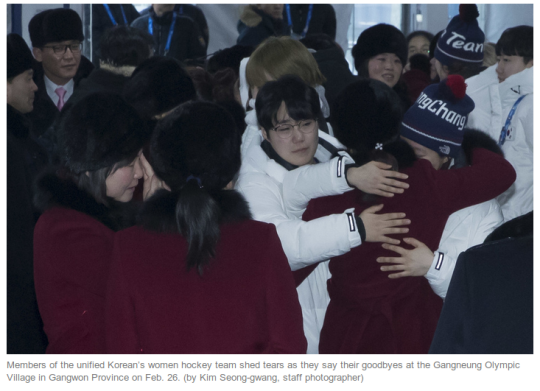
It was around 7:40 am on Feb. 26, and the welcome center in front of the Olympic athletes’ village in Gangneung was awash in tears. The bus was just 20 meters away, but it took the North Korean players on the unified women’s ice hockey team ten minutes to reach it. The South Korean athletes who had come to see them off embraced them tightly and would not let go. Team coach Sarah Murray and North Korean coach Pak Chol-ho also shared a tearful embrace. As they boarded the bus, the North Korean players opened the windows and reached their arms out to ease the pain of their goodbye.
“Who makes athletes cry? It’s just heartbreaking,” a Korea Ice Hockey Association (KIHA) official said.
On Feb. 23 and 24, the Hankyoreh visited Murray and the South Korean athletes at the Korea House in Gangneung’s Olympic Park to hear their fond memories of 33 days as a unified team.
When the 12 North Korean players first joined them at the Jincheon athletes’ village in North Chungcheong Province on Jan. 25, few truly understood how “peace” would become the 2018 Pyeongchang Olympics’ greatest legacy.
“The unified team was put together two weeks ahead of the Olympics, so there was a lot of concern,” Murray recalled.
But the unified Korean team proved the key driving force behind the Olympics’ success. The International Olympic Committee (IOC), which emphasizes the legacy of individual Olympics events, is certain to remember the Pyeongchang event as a “peace Olympics.” The puck used to score the team’s first goal in a Group B match against Japan is to be enshrined in the International Ice Hockey Federation (IIHF) Hall of Fame. Many foreign reporters could be seen cheering on the unified team members as they watched their matches. …
A
dozen women’s hockey players from North Korea hit the ice for the first
time with their new South Korean teammates this week, learning to
compete as a combined squad just days before the Winter Olympics start
this month.
Practice time is just one focus. They’re also still learning to talk about the sport together.
That’s
because the shared Korean language spoken by the two nations — divided
into the communist North and the capitalist South after World War II —
has diverged in the last seven decades, just like their respective
political ideologies.
Hockey is no different.
The
Korean-speaking athletes from the South, like others in the
Western-friendly nation, use English-influenced words in their postwar
vocabulary. Those from the isolated North, however, lace up their skates
while carrying a glossary of indigenous terms.
Take the “box out,” a term used for preventing opposing players from lingering near the net for rebounds.
South
Koreans say “bagseu-aut,” a Korean-accented version of the English
words that is foreign to North Koreans. They prefer the more literal
“munbakk-eu-ro mil-eonaegi” — or, “push out the door.”
My motivation was to show people that you don’t have to give up on your dreams to be who you are…I’ve been given a special opportunity to be visible for those who can’t be. Being a professional athlete, I’ve been given a platform to speak about my history and the things that I’ve been through. So hopefully the other people that have been going through what I’ve been through can kind of find a voice in me.
In some pretty great hockey news, Jessica Platt of the CWHL’s Toronto Furies has announced that she is trans and has been since swamped on twitter w/ tweets of support and admiration from teammates, fans and tons of others. It’s a good day for women’s hockey!
In this inspiring and entertaining talk, Hayley takes us through her rise to become one of the greatest female hockey players of all time, and introduces us to the challenges she has faced as a woman in a male dominated sport. Hayley shares what it has taken for her to buck the status quo and carve her own path, challenging us to find the courage to blaze our own trails. Hayley Wickenheiser is one of the best female hockey players in the world. A five-time Olympic medalist and national team member since age 15, Hayley’s passion for sport is matched by her desire to give back to the community – working with JumpStart, KidSport, Right to Play, Wickenheiser World Female Hockey Festival and dozens of organizations worldwide. Originally from Shaunavon, Saskatchewan and a graduate of the University of Calgary, Hayley’s numerous accolades include the Order of Canada, Canada’s Walk of Fame and The Globe and Mail’s “Power 50” influencers in sport. This talk was given at a TEDx event using the TED conference format but independently organized by a local community. Learn more at https://www.ted.com/tedx [12m:52s]


 Steel Phoenix Studios