The prosecutor who subpoenaed and cross-examined Hitler in 1931 for a murder trial against four brownshirts was a Jewish lawyer named Hans Litten. The three-hour testimony left Hitler so unnerved and humiliated that he forbade anyone speak Litten’s name in his presence, and he was killed in a concentration camp. Today, the German bar association is called the Hans Litten Association, and every year they give out the Hans Litten Award for excellence in the legal profession. That’s how you commemorate history.
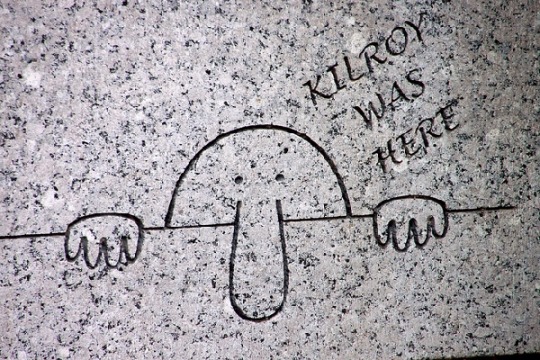
He’s engraved in stone in the National World War II Memorial in Washington, DC – back in a small alcove where very few people have seen it. For the WWII generation, this will bring back memories. For younger folks, it’s a bit of trivia that is an intrinsic part of American history and legend.
Anyone born between 1913 to about 1950, is very familiar with Kilroy. No one knew why he was so well known….but everybody seemed to get into it. It was the fad of its time!
At the National World War II Memorial in Washington, DC
So who was Kilroy?
In 1946 the American Transit Association, through its radio program, “Speak to America,” sponsored a nationwide contest to find the real Kilroy….now a larger-than-life legend of just-ended World War II….offering a prize of a real trolley car to the person who could prove himself to be the genuine article.
Almost 40 men stepped forward to make that claim, but only James Kilroy from Halifax, Massachusetts, had credible and verifiable evidence of his identity.
“Kilroy” was a 46-year old shipyard worker during World War II (1941-1945) who worked as a quality assurance checker at the Fore River Shipyard in Quincy, Massachusetts (a major shipbuilder for the United States Navy for a century until the 1980s).
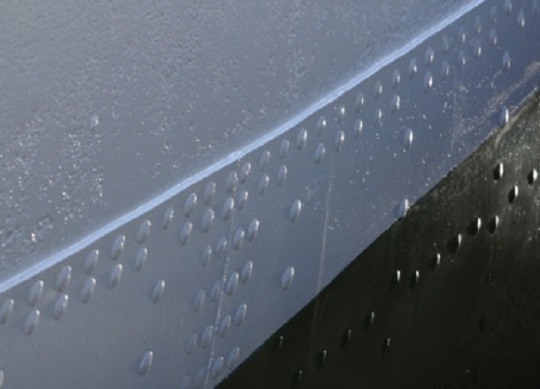
His job was to go around and check on the number of rivets completed. (Rivets held ships together before the advent of modern welding techniques.) Riveters were on piece work wages….so they got paid by the rivet. He would count a block of rivets and put a check mark in semi-waxed lumber chalk (similar to crayon), so the rivets wouldn’t be counted more than once.
A warship hull with rivets
When Kilroy went off duty, the riveters would surreptitiously erase the mark. Later, an off-shift inspector would come through and count the rivets a second time, resulting in double pay for the riveters!
One day Kilroy’s boss called him into his office. The foreman was upset about unusually high wages being “earned” by riveters, and asked him to investigate. It was then he realized what had been going on.
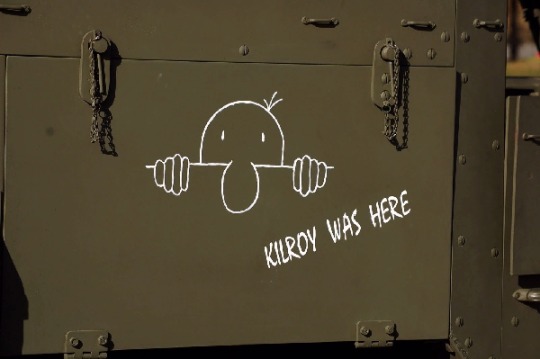
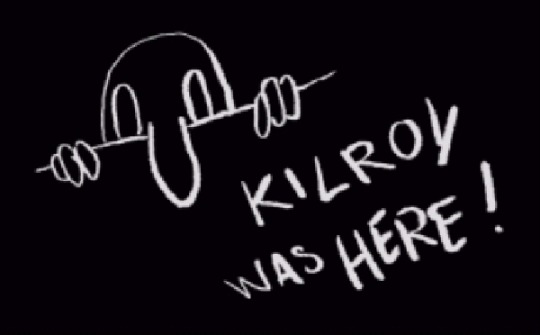
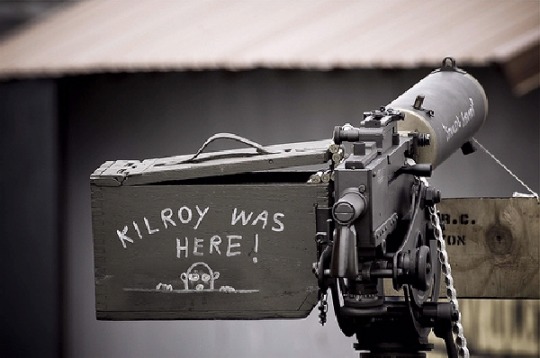
The tight spaces he had to crawl in to check the rivets didn’t lend themselves to lugging around a paint can and brush, so Kilroy decided to stick with the waxy chalk. He continued to put his check mark on each job he inspected, but added ”KILROY WAS HERE!“ in king-sized letters next to the check….and eventually added the sketch of the guy with the long nose peering over the fence….and that became part of the Kilroy message.
Kilroy’s original shipyard inspection “trademark” during World War II
Once he did that, the riveters stopped trying to wipe away his marks.
Ordinarily the rivets and chalk marks would have been covered up with paint. With World War II on in full swing, however, ships were leaving the Quincy Yard so fast that there wasn’t time to paint them. As a result, Kilroy’s inspection “trademark” was seen by thousands of servicemen who boarded the troopships the yard produced.
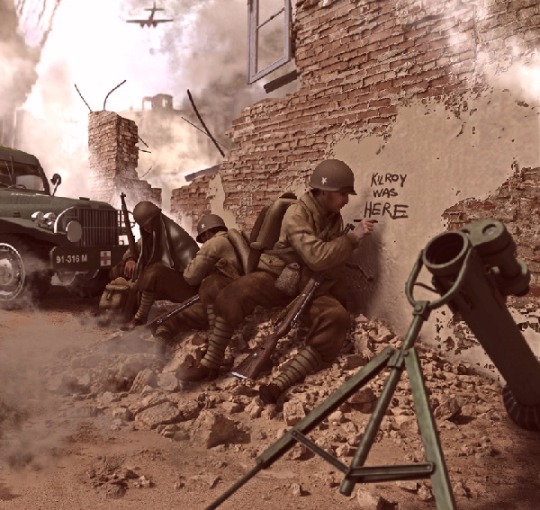
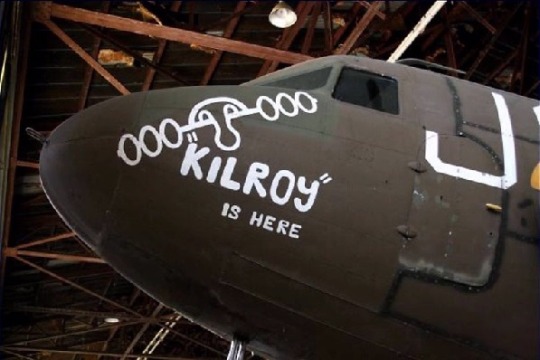
His message apparently rang a bell with the servicemen, because they picked it up and spread it all over the European and the Pacific war zones.
Before war’s end, “Kilroy” had been here, there, and everywhere on the long hauls to Berlin and Tokyo.
To the troops outbound in those ships, however, he was a complete mystery; all they knew for sure was that someone named Kilroy had “been there first.” As a joke, U.S. servicemen began placing the graffiti wherever they landed, claiming it was already there when they arrived.
As the World War II wore on, the legend grew. Underwater demolition teams routinely sneaked ashore on Japanese-held islands in the Pacific to map the terrain for coming invasions by U.S. troops (and thus, presumably, were the first GI’s there). On one occasion, however, they reported seeing enemy troops painting over the Kilroy logo!
In 1945, as World War II was ending, an outhouse was built for the exclusive use of Allied leaders Harry Truman, Joseph Stalin, and Winston Churchill at the Potsdam Conference. It’s first occupant was Stalin, who emerged and asked his aide (in Russian), “Who is Kilroy?”
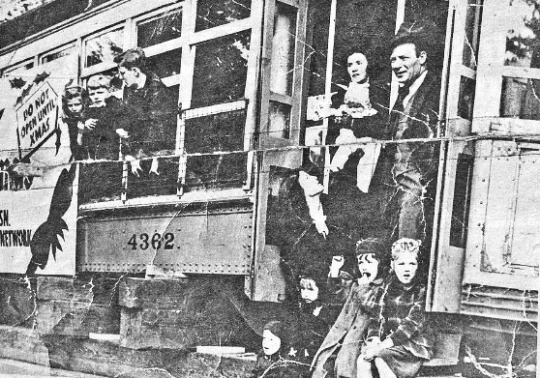
To help prove his authenticity in 1946, James Kilroy brought along officials from the shipyard and some of the riveters. He won the trolley car….which he
attached to the Kilroy home and used to provide living quarters for six of the family’s nine children….thereby solving what had become an acute housing crisis for the Kilroys.
The new addition to the Kilroy family home.
* * * *
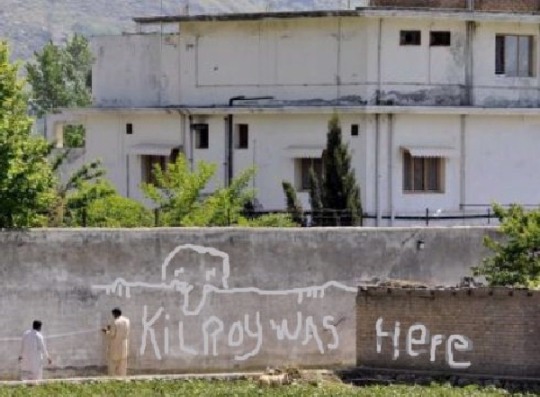
And the tradition continues into the 21st century…
In 2011 outside the now-late-Osama Bin Laden’s hideaway house in
>>Note: The Kilroy graffiti on the southwest wall of the Bin Laden compound pictured above was real (not digitally altered with Microsoft Paint, as postulated by some). The entire compound was leveled in 2012 for redevelopment by a Pakistani company as an amusement park….and to avoid it becoming a shrine to Bin Laden’s nefarious memory.
* * * *
A personal note….
My Dad’s trademark signature on cards, letters and notes to my sisters and I for the first 50 or so years of our lives (until we lost him to cancer) was to add the image of “Kilroy” at the end. We kids never ceased to get a thrill out of this….even as we evolved into adulthood.
To this day, the “Kilroy” image brings back a vivid image of my awesome Dad into my head….and my heart!
Dad: This one’s for you!
OMG I’m so glad to know this backstory.
I heard Kilroy had the first Tumblr account!
A proto-meme!
And in an abandoned water park in the middle of the Mojave desert:
its not even a hundred years from WW2 where nazi ideology & white supremacy quite literally got millions of ppl systematically murdered, and some ppl still act like nazism is “just an opinion” and that “everyone’s entitled to an opinion” as if it was something akin to a favorite color or food preference instead of a violent, manipulative, dangerous propaganda
Steve Rogers never got the serum. He doesn’t have superhuman abilities. What he has is a paintbrush, some stage props, a stomach full of spite, and a Bucky Barnes.
It’s enough.
Fic and Artwork Rating: PG
Warnings: –
Relationships: James “Bucky” Barnes/Steve Rogers, side Peggy Carter/Steve Rogers
Characters: Steve Rogers, James “Bucky” Barnes, Peggy Carter, Howard Stark, Tony Stark, Chester Phillips, Howling Commandos, Original Characters, random hydra assholes
Wartime drama based on historical fact: Steve helps create the myth of the supersoldier through the top secret workings of the Ghost Army!
New works are being posted to the CapRBB AO3 Collectionevery day until July 4th. Remember to check them out!
GUYZ, this fic!!!! The basic premise is that Steve joins the Ghost Army and fabricates Captain America. No one is serumed. The Howlies include Peggy (for the punching) and Howard Stark (for making tank noises).
What I love about it is that it normalizes Steve and Bucky’s wartime experiences. There’s no over-the-top world-saving, no special serum that makes their experience unique. Steve’s still a tiny spitfire, and Bucky’s still coping with wartime trauma, and basically just being two people who care a lot about each other and being thrown into war. Reading it made me think about all the people who fought in wars, then came home and went back to their lives and jobs – no ice, no HYDRA, just living.
I also love how Bucky and Steve fight with each other – their relationship is built from being stuck with each other and knowing each others’ stubbornness. It’s much easier to write selfless!Bucky and noble!Steve, so I have extra appreciation for the nuance here.
Remember that before the Holocaust, there were 18 million Jews in the world. They killed a third of us.
Remember that pre-war Eastern Europe was the center of world Jewry, and it had a thriving Jewish society with Yiddish theater, poetry, literature, art, and political activism. An entire society was destroyed.
Remember that before the war, a third of Warsaw’s population was Jewish. The vast majority of those Jewish residents were murdered.
Remember that Salonika (Thessaloniki) was a city in Greece that had a Jewish majority for hundreds of years. It used to be known as Sabatopolis – the Shabbat city – because before electric light, ships going by on Friday night would see a dark shoreline because the residents could not light lights. In the 16th century, it was known as the “mother of Israel” and was a center of Jewish life where Eastern European Jews would come to visit and study. Fewer than 1800 Jews from Salonika survived the Holocaust.
Remember that in Krakow, what used to be the Jewish quarter is now a tourist trap for the groups who come to look at what once was. The Jewish community owns several beautiful synagogues but only regularly uses one because there are so few Jews left. Without the tour groups who regularly pray with them, they would have trouble getting a quorum of ten men by the beginning of the Shabbat service. The other synagogues are museums now.
Resistance can take many forms – from education to litigation, from within a small community to throughout the globe. Though I have omitted highly important figures like Yuri Kochiyama and Fred Korematsu, I wanted to spotlight lesser-known individuals who resisted injustice in a variety of ways. They demonstrate that we too can act against oppression and inequality, however we are able.



 Steel Phoenix Studios