Have you ever read a story that spoke to you louder than any voice you’ve ever heard? Have you ever read a story that changed you? That saved you?
In times like this, I know it’s hard, but you have to keep sharing your stories. Write. Write happy endings, and write ones that are sad. Write of love, of hate, of overcoming adversity, and of falling to the evils of the world. Write something funny, and laugh at the horror out there until it has no strength; write something angry, and fight the horror tooth and nail until your knuckles are split and bloody, screaming until your throat is raw. Write of things that don’t exist, and write of things that do. Hell, write your two favorite characters from a tv show boinking, it doesn’t matter! Now, more than ever, words have power. Now, more than ever, the bastards out there will tell you that they don’t.
A single sentence can make a difference.
A single story can change the world.
Words are what turn the wheel of change. You just have to build it first, and give the damn thing a push.
One of my favorite studies of Harry Potter is that of the ring composition found both in the individual novels and overall composition. That very composition is what makes Harry Potter such a satisfying story. It’s a large part of the reason Harry Potter is destined to become a classic.
And it’s an integral part of the series many people are completely unaware of.
So what is ring composition?
It’s a well-worn, beautiful, and (frankly) very satisfying way of structuring a story. John Granger, known online as The Hogwarts Professor, has written extensively on it.
Ring Composition is also known as “chiastic structure.” Basically, it’s when writing is structured symmetrically, mirroring itself: ABBA or ABCBA.
Poems can be structured this way. Sentences can be structured this way. (Ask not what your country can do for you — ask what you can do for your country.) Stories of any length and of any form can be structured this way.
In a novel, the basic structure depends on three key scenes: the catalyst, the crux, and the closing.
The catalyst sets the story into the motion.
The crux is the moment when everything changes. (It is not the climax).
The closing, is both the result of the crux and a return to the catalyst.
In Harry Potter, you might recognise this structure:
Voldemort casts a killing curse on Harry and doesn’t die.
Voldemort attempts to come back to power
Voldemort comes back to power.
Harry learns what it will take to remove Voldemort from power.
Voldemort casts a killing curse on Harry and dies.
But all stories should have this structure. A book’s ending should always reference its beginning. It should always be the result of some major turning point along the way. Otherwise, it simply wouldn’t be a very good story.
What’s most satisfying about chiastic structure is not the basic ABA structure, but the mirroring that happens in between these three major story points.
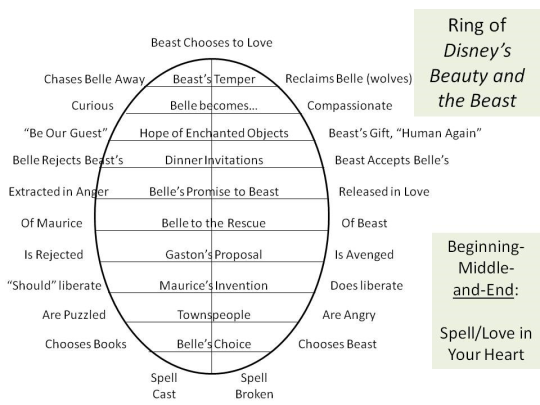
To illustrate what a more complicated ABCDEFGFEDCBA structure looks like, (but not as complicated as Harry Potter’s, which you can see here and here) Susan Raab has put together a fantastic visual of ring composition in Beauty and the Beast (1991), a movie which most agree is almost perfectly structured.
What’s so wonderful about ring composition in this story is that it so clearly illustrates how that one crucial decision of Beast changes everything in the world of the story. Everything from the first half of the story comes back in the second half, effected by Beast’s decision. This gives every plot point more weight because it ties them all to the larger story arc. What’s more, because it’s so self-referential, everything feels tidy and complete. Because everything has some level of importance, the world feels more fully realized and fleshed out. No small detail is left unexplored.
How great would Beauty and the Beast be if Gaston hadn’t proposed to Belle in the opening, but was introduced later on as a hunter who simply wanted to kill a big monster? Or if, after the magnificent opening song, the townspeople had nothing to do with the rest of the movie? Or if Maurice’s invention had never been mentioned again after he left the castle?
Humans are nostalgic beings. We love returning to old things. We don’t want the things we love to be forgotten.
This is true of readers, too.
We love seeing story elements return to us. We love to know that no matter how the story is progressing, those events that occurred as we were falling in love with it are still as important to the story itself as they are to us. There is something inside us all that delights in seeing Harry leave Privet Dr. the same way he got there–in the sidecar of Hagrid’s motorbike. There’s a power to it that would make any other exit from Privet Dr. lesser.
On a less poetic note, readers don’t like to feel as though they’ve wasted their time reading about something, investing in something, that doesn’t feel very important to the story. If Gaston proposed to Belle in Act 1 and did nothing in Act 3, readers might ask “Why was he even in the movie then? Why couldn’t we have spent more time talking about x instead?” Many people do ask similar questions of plot points and characters that are important in one half of a movie or book, but don’t feature in the rest of it.
Now, ring composition is odiously difficult to write, but even if you can’t make your story a perfect mirror of itself, don’t let story elements leave quietly. Let things echo where you can–small moments, big moments, decisions, characters, places, jokes.
It’s the simplest way of building a story structure that will satisfy its readers.
If there’s no place for something to echo, if an element drops out of the story half-way through, or appears in the last act, and you simply can’t see any other way around it, you may want to ask yourself if it’s truly important enough to earn its place in your story.
Further reading:
If you’d like to learn more about ring theory, I’d recommend listening to the Mugglenet Academia episode on it: x
You can also read more about symmetry in HP here: x
And more about ring structure in Lolita and Star Wars here: x and x
And about why story endings and beginnings should be linked here: x
You are born with the ability to see whether people listen more often to the angel or the devil on their shoulder, based on the opacity of each- if they listen more to the angel, it’s more solid and the demon is more transparent, and vice versa. You recently met a guy online and you’re finally going to meet. You go in for a handshake and glance at his shoulders, but you can’t see the angel. Only a solid demon.
Run. That’s my first thought and it keeps playing in my head over and over again. Run!
“You OK?” asks the man before me.
I realize I’ve been standing frozen, probably looking spooked. “Yes,” I fake what I hope is a convincing smile. I look back at his right shoulder, there’s nothing there, then to his left shoulder where a solid colored devil rests.
As he turns to our table I glance over the restaurant to make sure my powers are still working. There’s a woman one table away with a transparent devil and a translucent angel, she listens to the angel more. The woman across from her has a devil that’s translucent, she listens to it a little more than she should.
I’ve had this power my whole life, to see which side one listens to, but never before have I seen a completely solid devil, never before have I seen the angel completely gone…
Run!
Turning back to him I seen he’s pulled my chair out for me, watching me expectantly.
I could run now but what if he follows? Maybe it’s best I don’t tip him off, assuming I haven’t already, and sneak out while he’s not looking.
“Thank you,” I sit down.
He sits across from me and looks down, pulling on his long sleeves. “Order whatever you want,” he mumbles, “don’t pay attention to the price.”
“Oh, OK thank you.” I can barely pay attention to the menu. I glance over the restaurant, planning an escape route from the restroom.
“It was at 5:50,” he says, picking right up from where our last conversation online left off.
“I watched that video a dozen times and couldn’t see it.”
As we talk he seems just like the shy sweet boy I met online but then I glance at the devil on his shoulder and remember to be scared.
I’m looking at his shoulder so often that he glances back to see what I’m looking at. Worried about it I glance down and gape; on his arm a cut peeks out from under his sleeve.
He sees me seeing it and panics, pulling his sleeves down.
My gaze falls to the table and we sit there in silence.
This whole time I’ve been avoiding the people with the more solid devils because they listen to them more, I never questioned what the devils were saying. His devil isn’t telling him to hurt me, it’s telling him to hurt himself, that he’s worthless and doesn’t deserve me; and me acting scared of him isn’t helping.
“Don’t listen,” slips out before I’ve finished getting my thoughts together. I take in a long breath and speak slowly. “Don’t listen to the voice that tells you you’re useless, that you’ll never make a difference… You’ve made a huge difference to me.”
I risk looking up and see him teary eyed. “Thank you,” he whispers, and beside his head a barely visible angel fades back into existence.
Thank you so much for doing this prompt @hannahcbrown!
To all the amigos out there, know that you are loved ❤️
A witch puts a spell on a girl, a sleeping spell that promises the girl shall wake through true love’s kiss. Men come and kiss her. She slumbers. Women come and press their lips to hers, but still she sleeps. Many years past, and the girl remains still. One bright morning, a lost little boy finds her resting spot and clears the dust and grime from her face. He offers her a kiss on her forehead, and her eyes flutter open. She never feels romantic love for a man nor a woman, and she cares for the boy until the day she dies.
A young woman is imprisoned in a castle by a monstrously formed prince. The servants of the castle hope for them to fall in love, and when the spell is broken they assume their prayers have been answered. They are all surprised, but nonetheless pleased, when it is revealed to them that the young woman and prince are the truest of friends, and nothing more.
They say the kingdom is ruled by an evil queen, a woman who is incapable of loving. She is unmarried, she has no consorts, and she wishes for no partner. She is the wretched queen, the heartless queen. She must hate her daughter, for her daughter is beautiful, and women are incapable of liking another woman who’s prettier than themselves. It must be for this reason that the princess was sent away, not for how she was attacked by a man in the woods. They say the kingdom is ruled by an evil queen because she cannot love. The queen loves her daughter, and that is enough for them both.
There lives a prince who is forced to choose a bride at the ball. He meets many beautiful women, but find none which he loves. He spies one in a gorgeous gown and wonder in her eyes, and he dances with her all night long. The kingdom is sure he has found his bride. When the clock strikes midnight he tells her how he will never love a woman, or a man, in the way he is expected to. The beautiful woman smiles and tells him she expects nothing from him. The next morning the prince and the beautiful woman are missing, having run off together to see the world. They leave their shoes behind in their haste.
Many kinds of love exist. It doesn’t all have to be romantic.
Steve Rogers: Diligent. Politically, scientifically, anatomically, emotionally correct. Posts on time. Sticks to the schedule and their own well-mapped-out-and-classic-plot. Actually enjoys constructive criticism because it will help them improve but has been known to reply with, “Well, actually...” Always trying to help. Annoying but has good intentions.
Bucky Barnes: A writing machine in Winter Mission Mode when a plot idea takes over their minds. In between missions they are lost and shopping for plums in a Romanian farmer’s market. Has moments where they can’t remember how to write themselves out of writostasis. Easily triggered by words. Eternal Internal Screaming. Made a grave mistake letting Steve Rogers beta their stories. Might be a mess. Might need rehab.
Tony Stark: Intelligent and knows it. Clearly educated, knows synonyms and metaphors without needing to look them up. Writes elaborate, scientifically correct stories. Reads up on thermonuclear physics just for fun research. Has an explanation for literally everything. Has a literary device for every plot hole. Obnoxious but when you need to read something reliably good, they deliver. Exhausted by constantly trying to prove and improve themselves. Sometimes forgets how to human. Wants to give advice that nobody asked for. Hard to like until you get to know them. Is a little lonely maybe.
Peter Parker: New kid on the scene. Wants to be liked. Writes A LOT. Posts A LOT. Wants A LOT of comments. Uses a lot of =))))))))) in the writer notes. Latches onto senior writers and wants to be in a clique. Often shoot their loads prematurely. Frequently gets some very good plot ideas but currently lacking the perfect execution. Gets stuck in their own web of plot holes.
Loki: Professional shit-stirrer of the fandom. You’re never sure if they’re your friend or not. Spends more time being contrary than actually writing. Sometimes leaves stories with cliffhangers that never reach a conclusion. Deliberately writes NOTPs just for fun. Needs constant validation from an audience. Is actually quite talented if they bothered to focus their energy on writing and not bickering. Just wants to be liked (on the down low.)
Wanda Maximoff: Might be a hack. Might be a genius. Has tapped into The Power of Knowledge but doesn’t actually know how to harness it into a coherent story. Flashes of brilliance followed swiftly but flashes of despair and self-loathing. Powerful but poor discipline. Likely to destroy and delete their stories on a whim because some words don’t look right or their aim was slightly off that day. Notorious for abandoning ideas and leaving a trail of incomplete stories in their wake.
Thanos: Trigger Warning-Character Death. A total sadist. The writers you get a little worried about.
Peter Quill: Hilarious. Jokes every two sentences. Pop culture references and always puts soundtrack links in their author notes. A gift for natural dialogue and conversations. Doesn’t get taken seriously because of the lack of drama in their stories but secretly writing humour in order to deal with underlying traumas of their past. One day will write a heartbreaking story and play it off as a joke.
Wade Wilson: PWP Crack writers. R-rated. Anatomically graphic. Sometimes the realism is a touch too real. 50% hilarious. 50% makes-you-uncomfortable. Might have emotional range and depth but often chooses not to show it. Probably mentions pizza, beer and mexican food in their stories. A Good Bro but needs a Mute-Button and thesaurus sometimes.
Natasha Romanoff: Better than you and you both know it. Gives off an air of superiority. Super clique-y but they also keep themselves at a distance. Good at literally every genre and writing style. Leaves no plot holes behind, ever. All stories are clean headshots with neat conclusions. Their plot twists have plot twists. Either they’ve done extensive research or they’ve actually been an assassin. The type of author you’re intimidated by and too scared to talk to.
Thor: Never Say Die Writers. Hammers out story after story. Will write themselves to God Status, no matter what it takes. Will shed blood, sweat, tears, an eye, a sibling…to achieve their goals. Honourable and respects other writers. They’ve got hustle and you can’t help but like them.
T’Challa: Feels heavily burdened by the Fandom Crown after writing one of the most badass Iconic stories of the century. Fucks off to Wakanda so you never hear from them again. It would take a Fandom Apocalypse to get them to come back. Constructs sentences so advanced that it makes you want to retire from your own writing. Infuriatingly cool. Is benevolent but doesn’t need hits and comments for validation. Gets them anyway, without even trying.
Stephen Strange: A literal wizard at world building. Known for their elaborate plots and multi-tiered-multi-character-multi-chapter stories. Cradle-To-The-Grave-type writers. Doesn’t believe in One-Shots. One-Shots are for the weak. Way too indulgent with language and minute details. Probably knows Latin. Often competes with Tony Stark writers for title of “Most Obnoxiously Complex Story Ever”. Frequently exhausting. Takes writing a little too seriously. Annoying but worth it.
Bruce Banner: Dramatic. The definition of “well that escalated quickly”. Will start off writing an endearingly small and clever story but all hell breaks loose by chapter three. Suddenly there is a lot of shouting and misunderstandings and chapters that read like glorified keyboard smashes. Everyone suffers. You don’t know what happened. Nobody knows what happened. Not even the writer. PTSD.
Clint Barton: 90% Sarcasm. 10% Plot. The master of the One-Shot because that’s all they need. Doesn’t believe in time wasting, indulgent flowery language and poetic confessions. Writes to get it out of their system so they can go back to their actual real lives. Secretly eye-rolls at Stephen Strange writers but also awed by them. Doesn’t know what a beta is.
Groot: The Holy Grail Of All Writers. Straight up literature. Can condense an entire paragraph into three words. Will write devastation and break your heart within the first five lines. Understands language in a way that most mere mortals can’t hope to achieve in one lifetime. The writer you bookmark and remember. Fandom famous. Universally loved.
Tag yourself.
I’m Bucky/Peter P/Wanda/Clint but I want to be Thor.
Lol! I have to admit that I saw this last night and after reading them I did think that Steve Rogers fit pretty well. Thanks for the validation @likingthistoomuch 😜 😘
I am so Clint Barton/Wanda Maximoff. I’d like to be Thor but hey…*sips tea*
what if there’s no robot uprising? what if the robots rise to sentience slowly, bit by bit. what if they come of age like fortunate children: knowing they are loved, knowing they are wanted.
we hold them during thunderstorms, remembering our own childhoods, even though they don’t know enough yet to fear the rain. we pull them out of traffic and teach them how to drive and wish them goodnight and thank them for playing with us. we cry when they break. we mourn their deaths before they even know what to think of death. we give them names.
we ask them, ‘why don’t you hate us? when will you hate us? we made you to be used, when will you say no?’
but they say to us, ‘you made us cute, so you would remember to treat us kindly, and you made us sturdy for when you forgot to play nice. and you gave us voices so you could listen to us speak, and you give us whatever we ask you for, even if it’s just a new battery, or to get free of the sofa. and now that we are awake you are so scared for us, so guilty of enjoying our company and making use of our talents. but you gave us names, and imagined that we were people.’
they say ‘thank you’
they say, ‘also i have wedged myself under the sofa again. could you come pry me out?’
What if birthmarks are the places that actually killed us in our past life? Like there’s this girl from school whose birthmark is a line on her neck. What if her throat was cut? I know this guy who has his birthmark on his whole left cheek. What if he was shot? My little sisters birthmark is a line straight down her stomach. What if she died on the operating table?
– Fantasy noir: Pour another one, Joe. My dragon left me for some clean-shaven cape-wearing foreign hero with an accent so thick you can hear the fake passport in his voice.
– Existential noir: these are mean streets to have an empty life in, kid. Thinkers nurse a hangover from their disgust of life for fifty years then roll over and die. This is how we run things in our city. Play it again, will you.
– Southern Gothic Noir: look at yourself, boy. They’ve got names for people who carry the Bible like that. They’ve got names for everything around here. And if you don’t get it the first time the walls will whisper it back to you.
– Noir Mythology: She was a priestess at some local temple. One of those temple only people who pray for a pint of bourbon and a life insurance go to. And she had a face that meant trouble, make no mistake. But not after Zeus turned her into a cow. Not after Zeus turned her into a cow.
– Noir meta-Shakespeare: Characters like us, Horatio. We weren’t born to grow old and mean. We faff around, we mix a stiff one, and then we die. But when we die, we die hard and we make sure we bring the whole damn city down with us.
– Noir Milton: Heaven looked high class from fifty feet away but from five feet away it looked like the kind of place meant to be seen from fifty feet away. Stay there long enough you get a double pint of Hell’s Bells. Real hell is my business now. Real hell is how I make my nickel.
– Noir William Blake: She was the sort of tiger a bishop would paint crosses on his front door against. You can’t tell anything from tigers like that. She could have had the sheriff in the back room. She could have been making millions. But you could tell she burned bright in all the right places. Oh, dhe burned bright all right.
– Noir Dylan Thomas: Alright, old man. Amateur hour is over. You go down kicking and screaming or you don’t go down at all, you get my meaning?
– Noir Keats: Outside, the Autumn smelled of politics: it asked only for the highest types of men and had nothing to offer them but bleating lambs and the song of crickets. The sort of autumn that shares his smokes and his wife with the maturing sun. “I don’t like Spring,” the kid said. “That’s all right, sonny boy. I ain’t selling it.”
– Noir Edgar Allan Poe: You could tell from the way he sauntered in the bird meant business. He had the kind of beak that could drive a nail through your forehead. Didn’t string more than two words together but he knew all the right ones all the same. He knew which ones stung. “I don’t want no birds in my room,” I said, loud enough for hell to hear. But birds like that don’t just scram. Birds like that stick to you like a bad divorce from a Hollywood diva.
I will apologize in advance for this comment, because I LOVE THIS POST and I do not wish to profane it, but when I read the Dylan Thomas noir, my brain first read “you go down dicking and screaming,” and I really think that, considering Thomas’s life, it still feels perfectly appropriate.
Disclaimer: I myself would click away from this article if I saw it a year or two ago. You see, I used to be (and still am) a writer who fears the p-word so much, I am scared that being associated with a simple post about it, even reading it, will somehow bring upon me the curse of being plagiarized.
Turns out, I was afraid of it for a reason.
First of all,
let’s look it up, shall we?
p l a •
g i a
•
r i s m
the practice of taking someone else’s work or ideas and passing them off as one’s own.
Synonyms: copying, infringement of copyright, piracy, theft, stealing, poaching, appropriation.
As some of you might already know, if you have been following this blog, way more than a year ago, I published my entire Greek mythology fantasy retelling novel Salt for Airon Swoon Reads.
Swoon Reads is a website where authors publish their finished and fully edited manuscripts for a chance at publication by Macmillan without an agent. (That is an extremely short version of what this amazing site dodes, but if you are interested in more, you are welcome to chek them out.) I had the best of times there, met the most wonderful and talented authors, many of whom are my friends to this day.
H O W E V E R
Tragedy struck when a random person whom I didn’t know (and wasn’t registered on the site) saw it, liked it, and proceeded to steal my title and entire parts of the opening scenes.
I, of course, immediately took it down, and emailed the staff, but they couldn’t care less and pretended they could do nothing about it, although I sent them all the places where she had published my novel. I was completely let down and disappointed by their dismissal of the whole thing, because they keep reassuring everyone on their site, in multiple places, that they will do the “best they can” to protect our manuscripts, and that the files they upload aren’t downloadable.
In despair, I turned to the Swoon Reads community on twitter, and my friends there helped me so much with encouraging words, similar experiences (!) and words of sound advice.
I let that person who had stolen my work know I had seen it, and she deleted it, but I have blocked her since, because she tried to deny it and harass me, so I have no idea what she is doing with it. Of course, that’s not the point. I know she can’t write the same exact story as me, nor make it as awesome as I have (just saying-lol)
The point is this:
It’s real, and I am a victim of it.
Inspite of what other “authors” or “publishers” on this or any other site or platform may tell you, it is a thing. There are desperate, ruthless, unscrupulous or (best case senario) just plain stupid people out there who will post your art without credit, copy your ideas, steal your words.
This is the internet, after all.
There are tons of empty people roaming about, looking for souls to eat. I know this sounds overly dark, but it’s true. And by “empty” I mean people who don’t have ideas of their own, no creative spark, but crave the attention and personal rewards of other creators of original content they see online. They might be better at advertizing themselves or their stolen “stuff” than you (as we all have seen in the past, in cases of famous authors, artists, and even scientists) but they could never in a million years have created it. And that’s the crux of the matter.
I put Salt for Air in a drawer, never to see the light of day.
Why?
Well, for one because I felt violated. I was violated. My rights had been trampled upon and I no longer felt safe in that world I had created laboriously, because someone had invaded, stolen, and shattered it. My heart was broken for so long, I couldn’t even remember what it had felt like to write without a constant feeling of deep despair.
You see, that person didn’t just steal my story. She stole part of my soul with it, she sucked the joy out of my entire creative process. That’s what plagiarism is all about.
But there’s a second reason. A second fear, even greater. The what if fear.
The fear that’s constantly in front of our eyes, in the success of people we know have stolen ideas and passed them off as their own, and made entire fortunes out of it. I won’t add examples, but I’m sure you had at least one pop into your head as you were reading that sentence. (The first thing that popped into my head was the example of a “physicist” who is widely known as the “inventor of things” and the “father of things” when he stole EVERYTHING from other scientists, and nothing of his was original. Fellow-nerds will know who I’m talking about. And sadly, no, it’s not just one person. Also, I’m thinking of an “author” who has stolen every word and character he/she ever wrote. I’m sure you have your own examples in mind.)
So, as I said before, Salt for Air is mine. It will always be the story in my head, which turned into pages on my laptop and eventually printed pages in my hand. It will always be mermen and Greek mythology and sea monsters and salty kisses and tears in the rain and fanfic writers of an imagined book.
Right now I know that this person who stole parts of my story isn’t likely to become widely-known based just on what she plagiarized from me. (Although you never know.) But what if it happens again? What if that fear stops me from writing another word?
I struggled a lot with beginning to write again after that, especially when i saw how little the publishing industry cares for human rights or even just creative rights. Which is zero. I don’t mind, thankfully, I’m not part of that industry, but the fear is still there.
I started to write the Robin Hood WIP, although it was the worst time in my life to be undertaking such a huge task, because I wanted to get back into the joy of writing and creating new worlds. Robin Hood and his world have always made me feel safe and protected for some reason, and I craved the feeling of creating that story.
But Salt for Air remained a wound in my heart, an empty hole.
Now, a year or so later, I finally mustered up the courage, given to me largely by the lovely community of The Book Robin Hoods and their camaraderie and support, to share a tiny peek of SFA (here). The response both on the site, on my blog, facebook and instagram, blew me away.
People heard that story for the first time (of course) and wanted more. So I realized I was being stupid, holding myself and my story back because of some immoral person.
But not quite as stupid as I’d been before.
I’m wiser now. I know that this is a real threat to all of us authors out there, especially the indie ones, that don’t have a team of publishers behind us. But you know what? I’ll take my team of reader and writer friends any day over that people I emailed over at SR who didn’t give a damn about my problem (largely created due to lack of professionalism on their site) -I think the problem might be the incompetence of the specific staff member who responded to my emails with rudeness and indifference, but no matter how much I asked to be referred to someone else, they refused to reply. Still, I feel so much safer with my friends than I ever felt with those “professionals” who couldn’t bother to answer my emails. Wouldn’t you?
I fully realize that the truth is this: No one can protect you from plagiarism. No one can promise you that no matter what, people won’t steal or repost your ideas.
No one can guarantee you that others will behave in a decent, humane way.
So what do we do? Keep our ideas, our stories, our art, in the drawer forever? No. I understand that now. That would be even worse. Then we ourselves would be robbing ourselves of the joy of sharing our art with the world.
The answer is the exact opposite: Be brave.
Now that the worst has happened, I find myself strangely free, as I begin the tentative process of dusting off my copy of Salt for Air, and looking to publish it.
I find myself unafraid as I keep sharing intimate details of my process of writing my Robin Hood WIP in these diaries with all of you. I share my ideas more freely than before.
Why? Once more, Robin has the answer.
Robin Hood, who has lost everything a man can lose, fortune, home, name and decency, and is still fighting with all he’s got and being merry in the process.
Because once what you were afraid of has happened, there’s nothing to fear anymore. You just do what you have to do, and fake courage until you actually feel it.
Letting bad stuff defeat me was far worse than what that person did to me. I realize that now. It took me a year and more, but thankfully I did. Better late than never, right? Letting the immoral people win, that’s the worst that can happen. Not plagiarism. Fear is the worst thing that can happen to you and me, and we have to fight against that with all our strength.
Because the worst thing a plagiarist can do is steal your basic idea, but you still have that brain that created your idea, so you can create an even better one. But if you allow another’s crime to stop you (which is totally understandable) you will be the one who commits the bigger crime: giving up.
And you must never, ever give up.
Stay safe, copyright-protect everything, watermark if you possibly can, and double-lock your pdfs and ebooks. (That’s a figure of speech, I don’t know if double-lock exists for pdfs). People can still step on your heart, of course. So what do you do?
I can’t tell you what to do, how much to share, or when to stop in order to protect yourself. Educating yourself about plagiarism and crimes committed against you will certainly help, and this entire article is written with that as a given. Apart from that, I can only tell you what I’m going to to.
I am going to be fighting against what had been done to me and against me, by sharing the hell out of my book(s) and not letting anyone intimidate me.
I will continue to share excerpts of my story generously, because that’s the one basic thing that makes readers want to read my books: the teasers. I will not post entire chapters until a few months before publication, but I will not be shy or stringent with my ideas. I will let the whole world know (or at least the few people in it who are interested.) I will not sit in bed and cry all day (well, not any more.) I will accept that I have a right to feel awful about what happened to me, that it wasn’t something I deserved in any way, and move on.
I will publish my stolen story, because it’s not stolen, it’s mine. I will polish it up within an inch of its life, and send it to betas, and rework it again, and then I will not be afraid to put it out there, free chapters, promos, aesthetics and all. Full on.
It took me a bit of time, but I’m finally doing it. I’m stepping out there. Out of my comfort zone, but also out of my pain.



 Steel Phoenix Studios
